A noisy-space action-value function that assigns value to diffusion latents through their induced clean actions, and a policy gradient that optimizes them without backpropagating through denoising.
Diffusion policies offer a powerful and expressive parameterization for continuous control. Yet, their integration with reinforcement learning remains conceptually and algorithmically challenging. In this work, we address this gap by introducing a noisy-space action-value (Q-)function that assigns values to diffusion latents through the distribution of executed actions induced by the denoising process. We show that this construction admits a precise semantic interpretation and derive a noisy-space policy gradient (NSPG) that optimizes noisy latents using only clean action-space value estimates. Building on this result, we formulate a KL-regularized policy improvement over noisy latents and show that the resulting objective admits a diffusion-compatible regression form, avoiding backpropagation through the denoising process. Empirical results on state-based D4RL benchmarks and vision-based OGBench tasks demonstrate that the proposed noisy-space objective provides a principled and effective basis for training diffusion policies in offline reinforcement learning.
A diffusion policy generates actions by iteratively denoising a sequence of noisy latents into a clean sample, so optimization takes place in a noisy latent space. Reinforcement-learning objectives, however, are defined over the executed actions that interact with the environment. Prior methods either treat the diffusion model purely as an action sampler or evaluate a critic directly on noisy latents. We instead define the connection between the two spaces explicitly through $Q_{\text{noisy}}$.
Policy improvement, sampling, and the denoising trajectory all live here. Latents $x^{(k)}$ share the action's dimension but are not actions — the environment never sees them.
Rewards, transitions, and the critic $Q^{\pi}(s,a)$ are defined only over executed actions $a \in \mathcal{A}$. This is the only space with genuine MDP semantics.
A diffusion policy does not emit an action in one pass. It starts from noise and runs a reverse denoising trajectory $x^{(T)} \rightarrow \cdots \rightarrow x^{(0)}$, where only the final sample is executed as $a=x^{(0)}$.
The key point is that an intermediate latent $x^{(k)}$ is not an action in the MDP. It is a conditioning point in the generation process, and after the remaining denoising steps it can induce several compatible clean actions.
Design principle. Value belongs to executable actions. NSPG keeps the critic in clean action space, then lifts the resulting signal back to noisy space.
NSPG gives a noisy latent a value only through the clean actions it can produce. Instead of asking the critic to score $x^{(k)}$ directly, we evaluate executable actions and average their returns under the distribution induced by that latent.
The gradient then becomes an advantage-weighted score in noisy space: compatible actions with above-average value reinforce the latent direction, while below-average actions are suppressed.
This separates NSPG from decoded guidance, as used for example in Diffusion Q-Learning-style updates. Decoding first commits to one clean estimate $\hat a(x^{(k)})$ and then optimizes $Q(s,\hat a)$; NSPG keeps the full compatible-action distribution, where multimodal behavior and high-value modes can diverge.
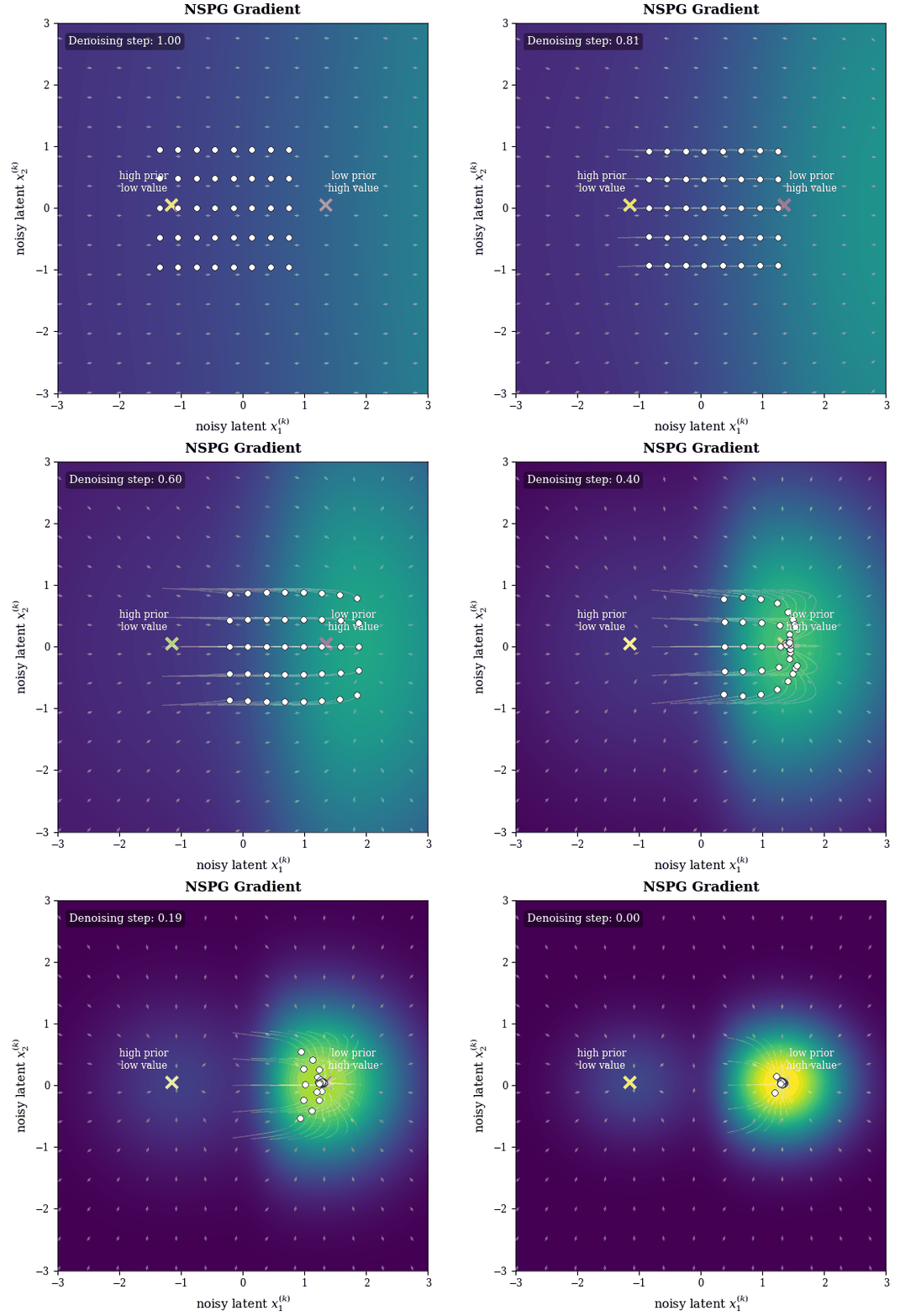
Expected-value guidance. The latent is optimized through all compatible clean actions, so high-value samples can pull the update even when they are not the densest mode.
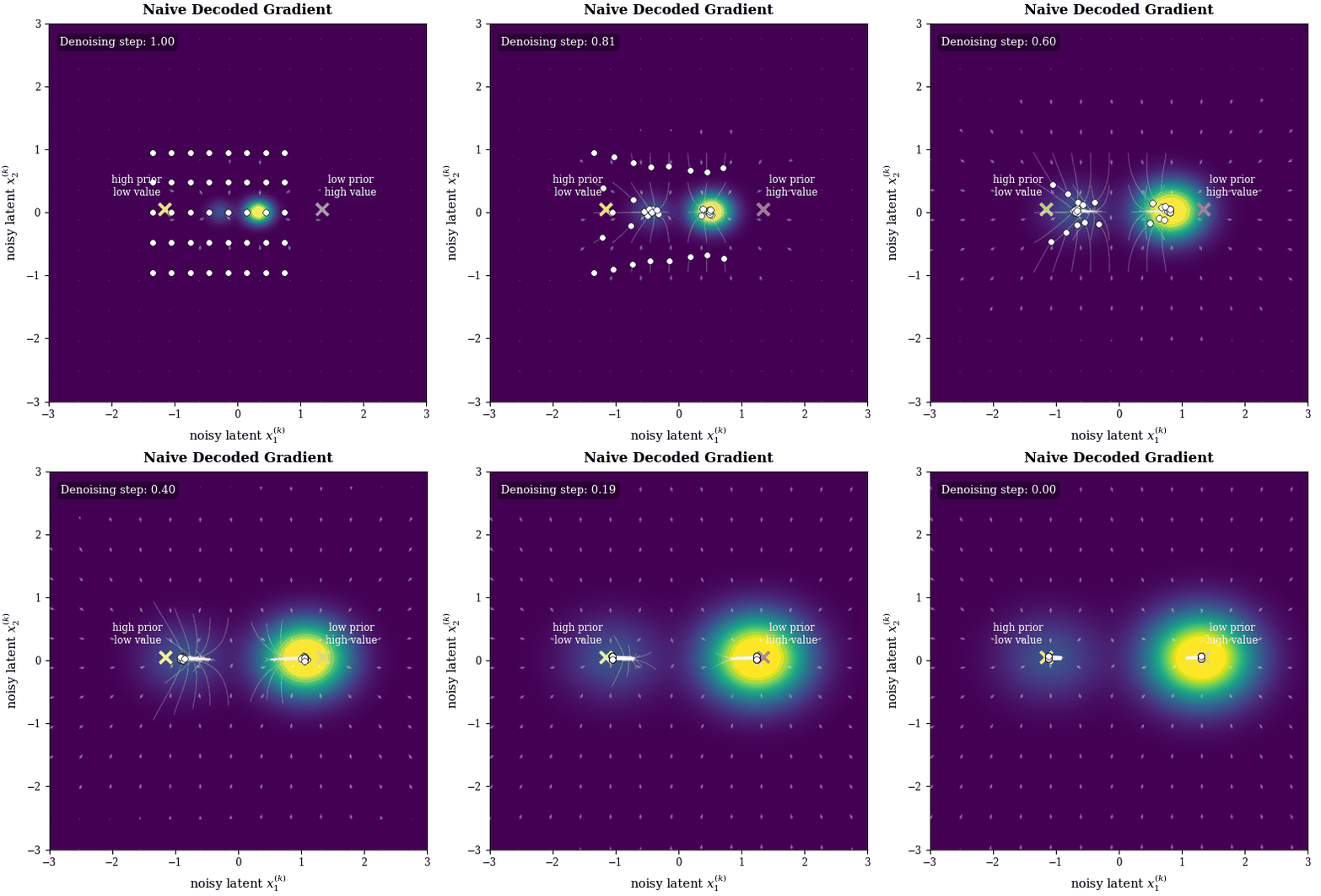
Decoded guidance. In DQL-style updates, the latent is first collapsed to one clean estimate $\hat a(x^{(k)})$, then the critic is applied to that single point.
Noisy-Space Actor–Critic alternates between a pessimistic action-space critic (a lower-confidence-bound over an ensemble) and a diffusion actor improved by the noisy-space gradient.
The improvement objective rewrites into a denoising regression with a value-guidance term, so the actor trains exactly like a diffusion model — with no backpropagation through the denoising trajectory, and the critic never evaluated on noisy latents.
Each iteration updates the critic toward a conservative Bellman target, then nudges the actor along $\nabla_{x^{(k)}}Q_{\text{noisy}}$. Value estimation stays entirely in action space; policy improvement happens in noisy latent space.
This work makes the following contributions to value-based optimization of diffusion policies in offline reinforcement learning:
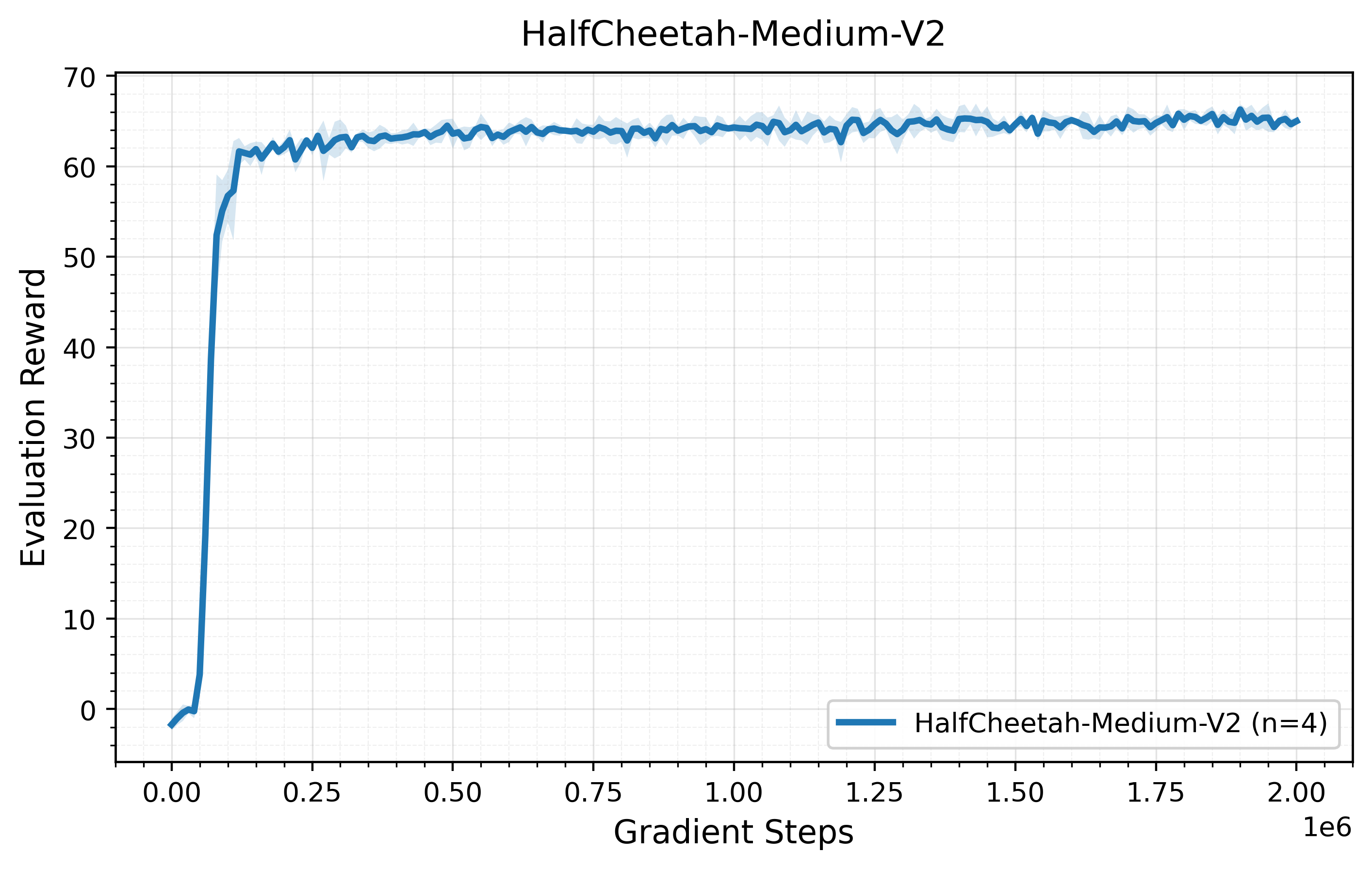
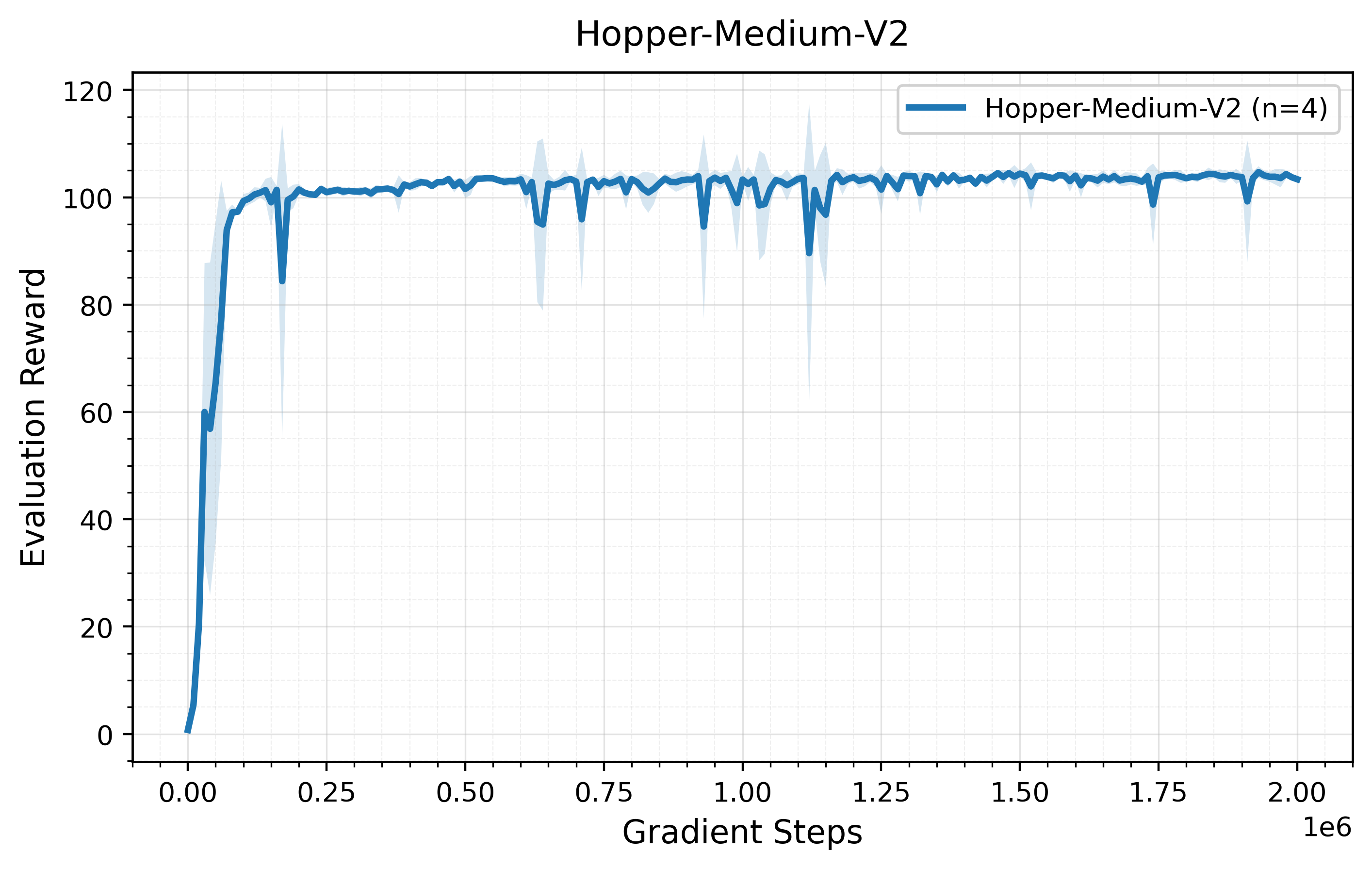
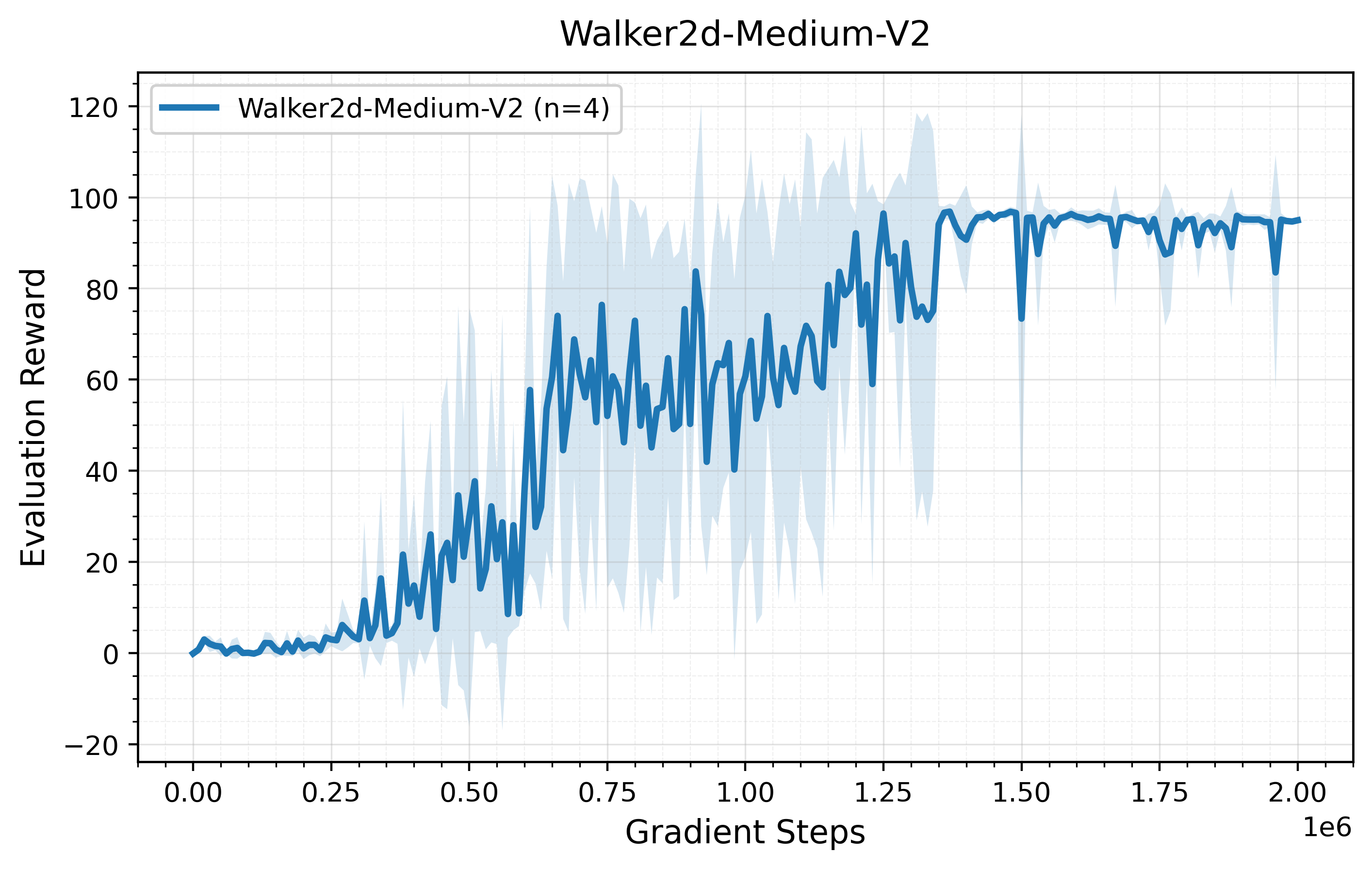
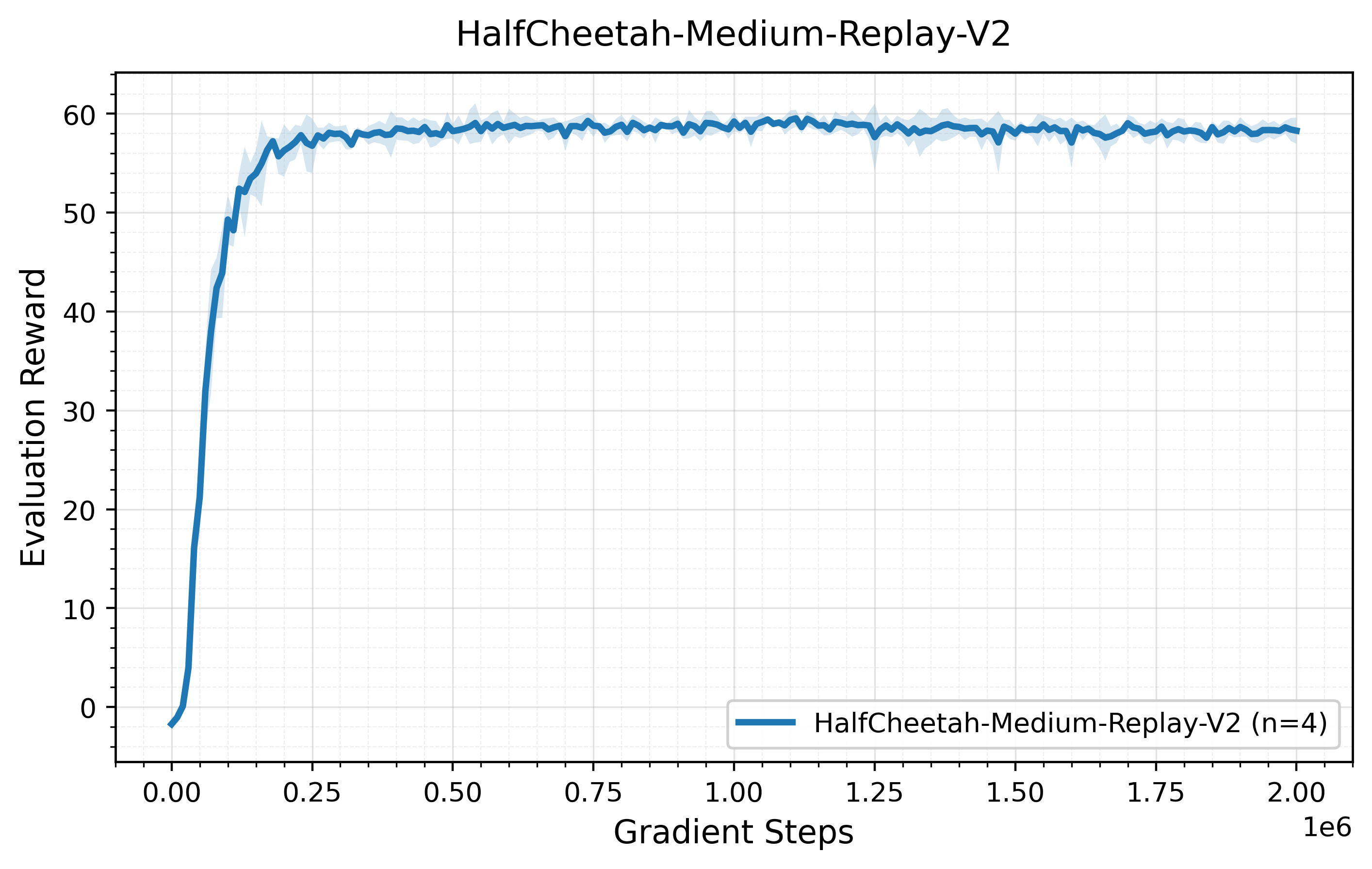
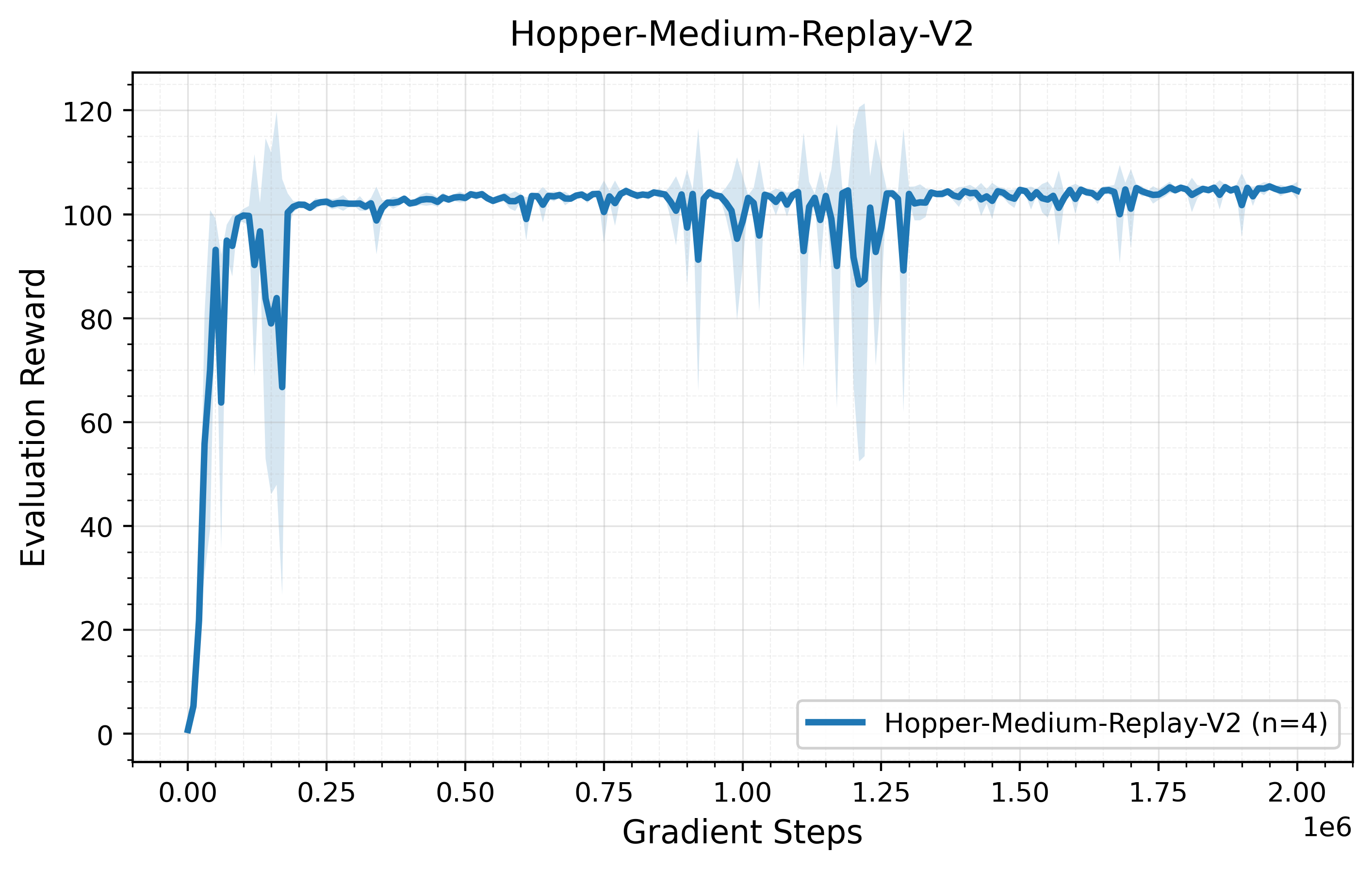
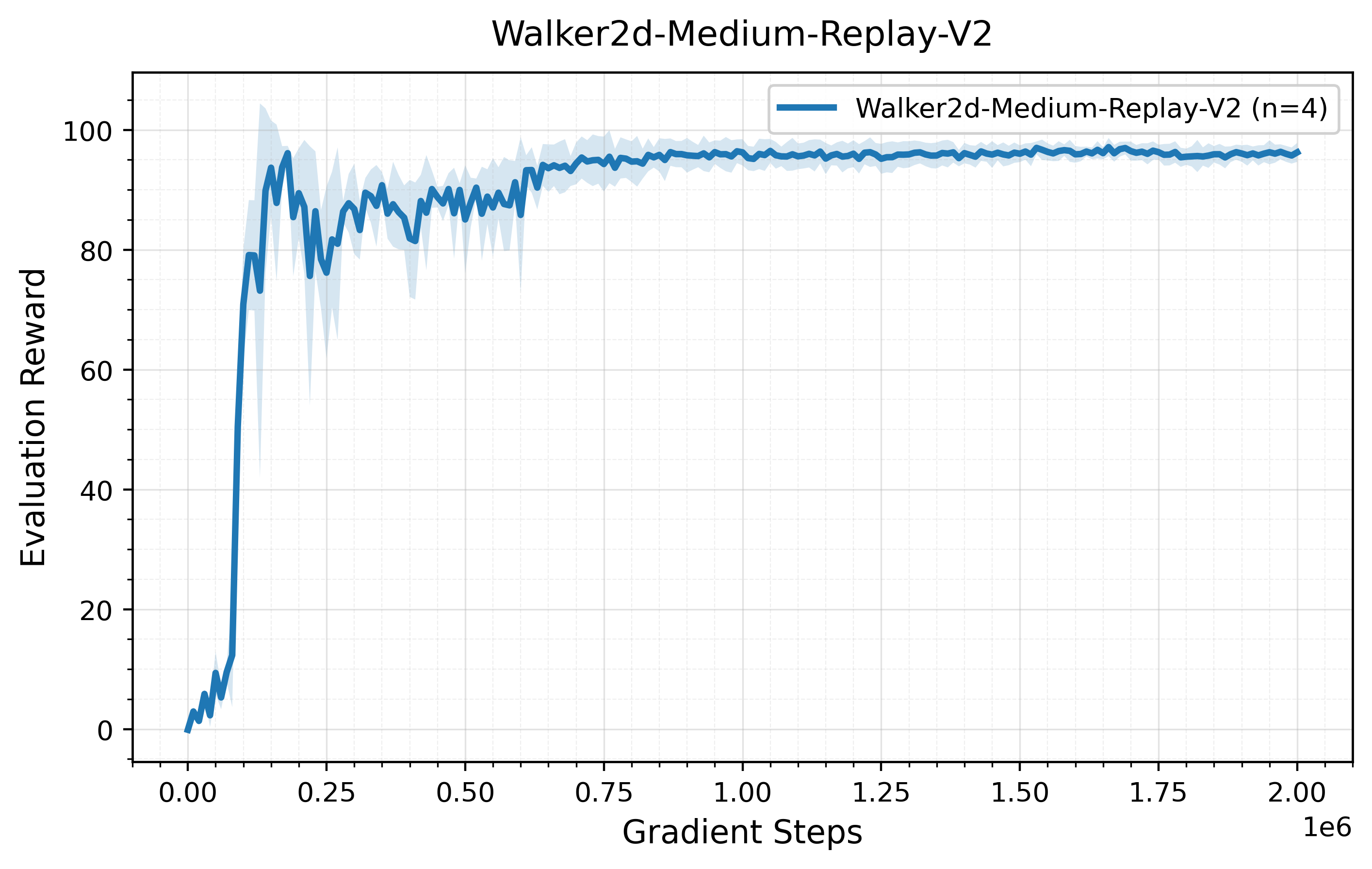
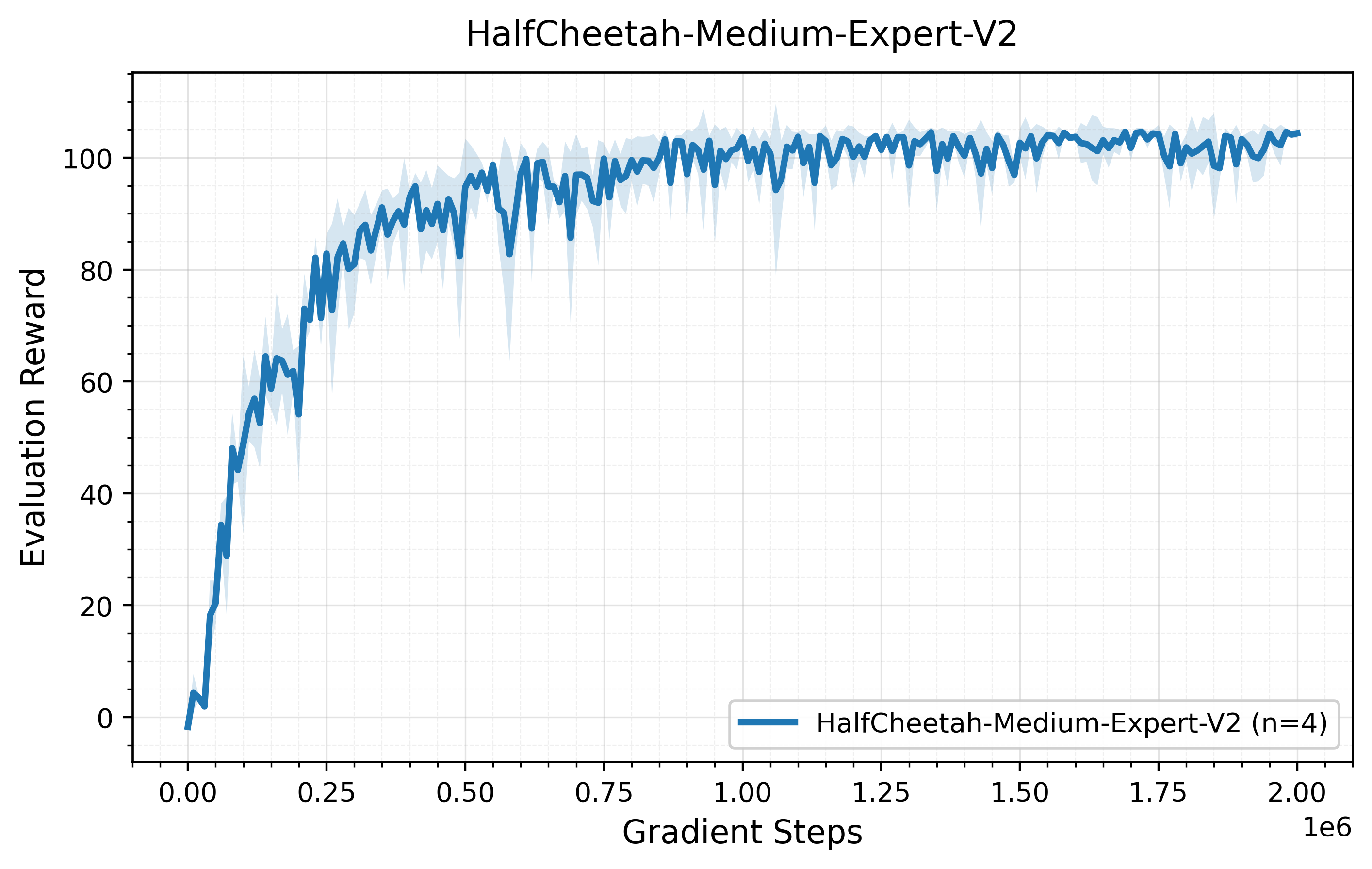
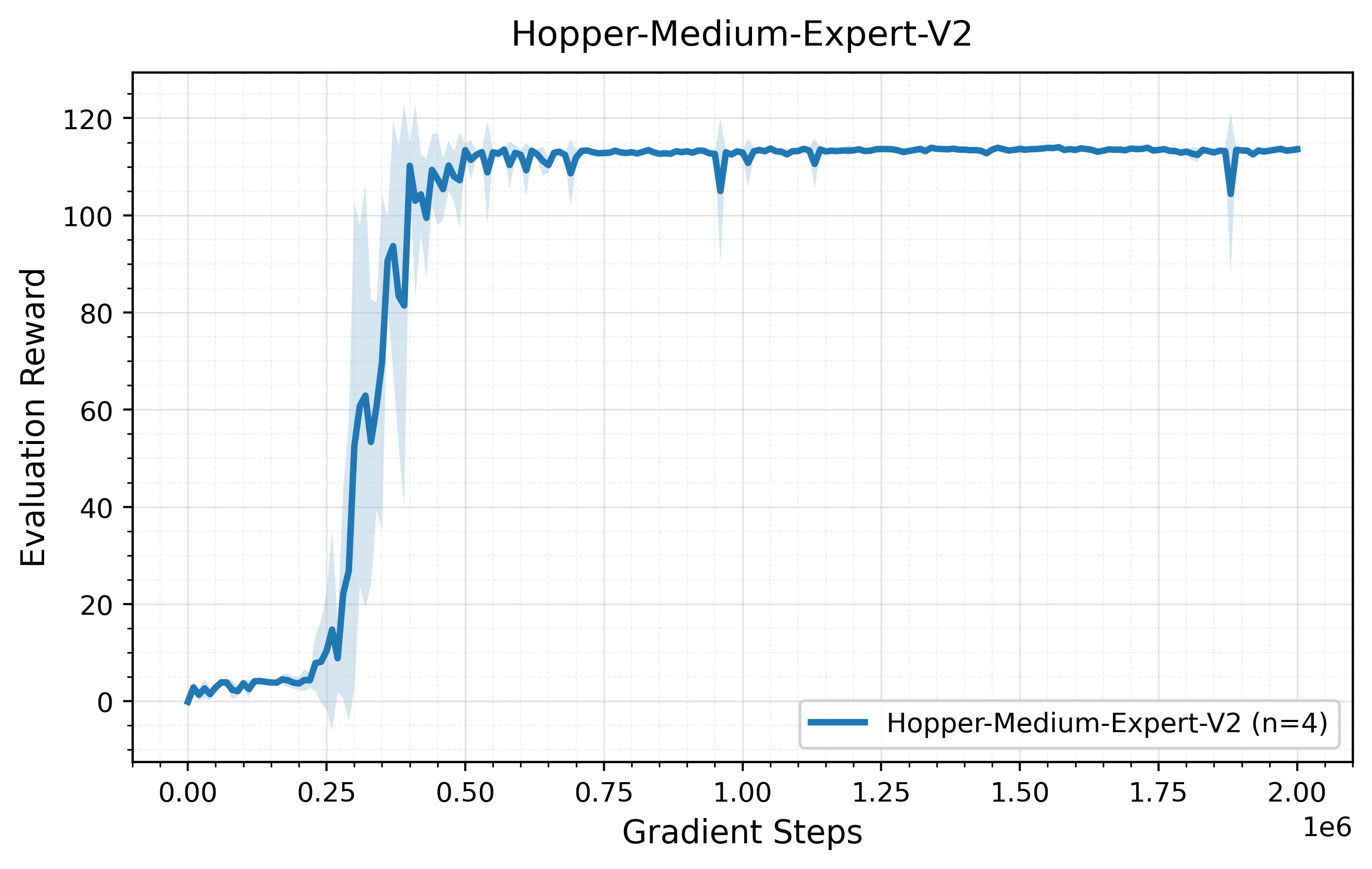
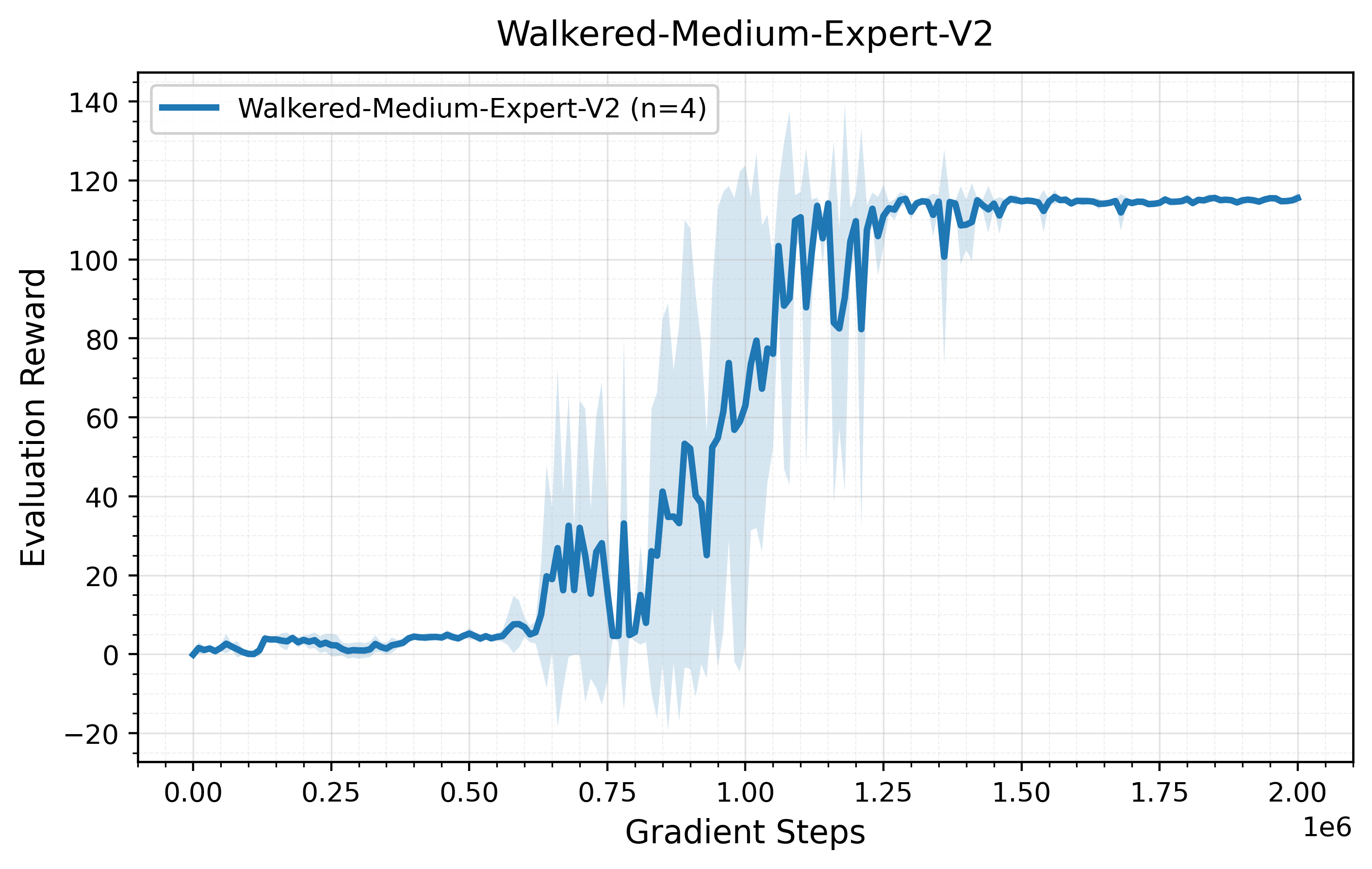
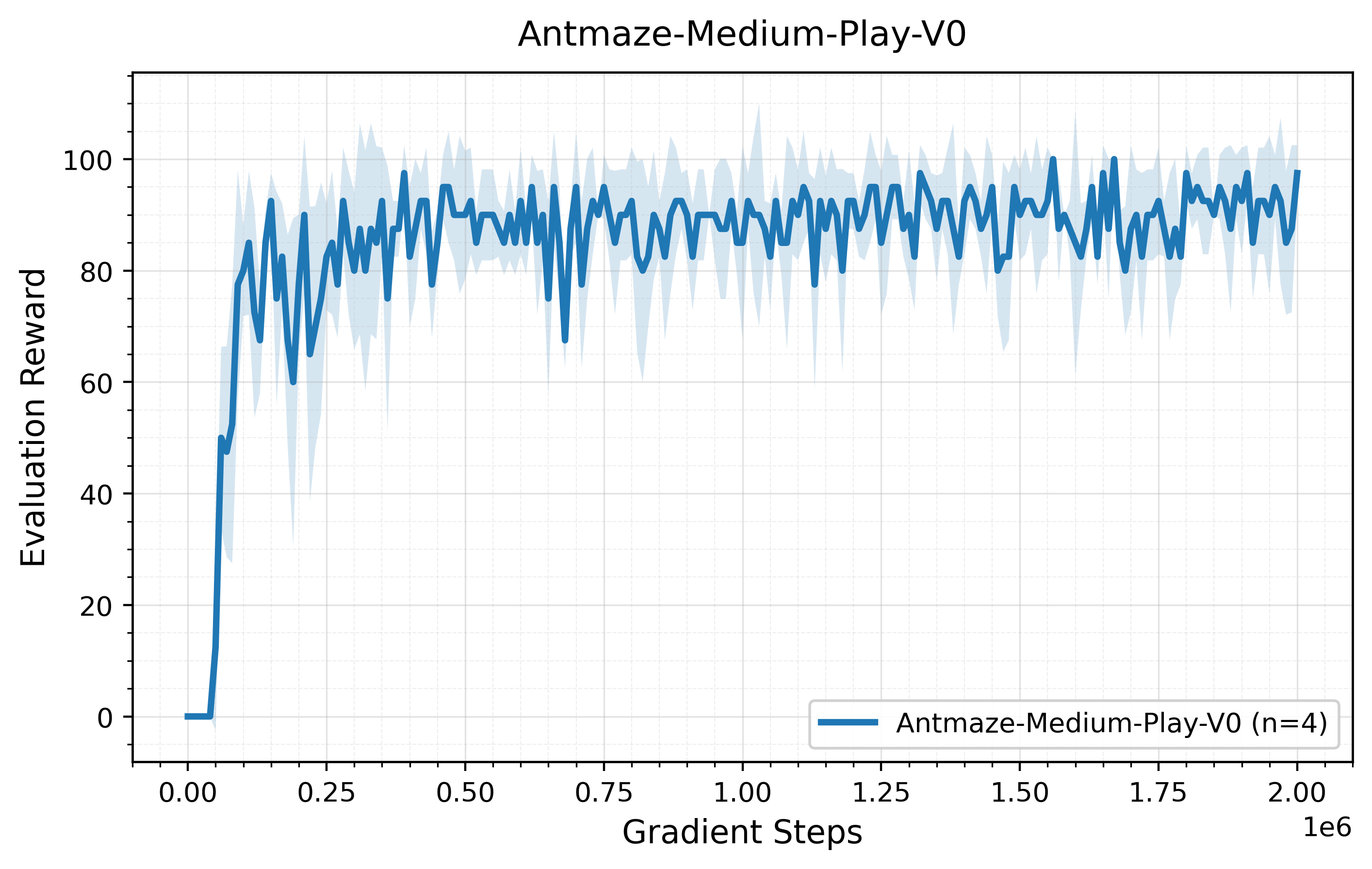
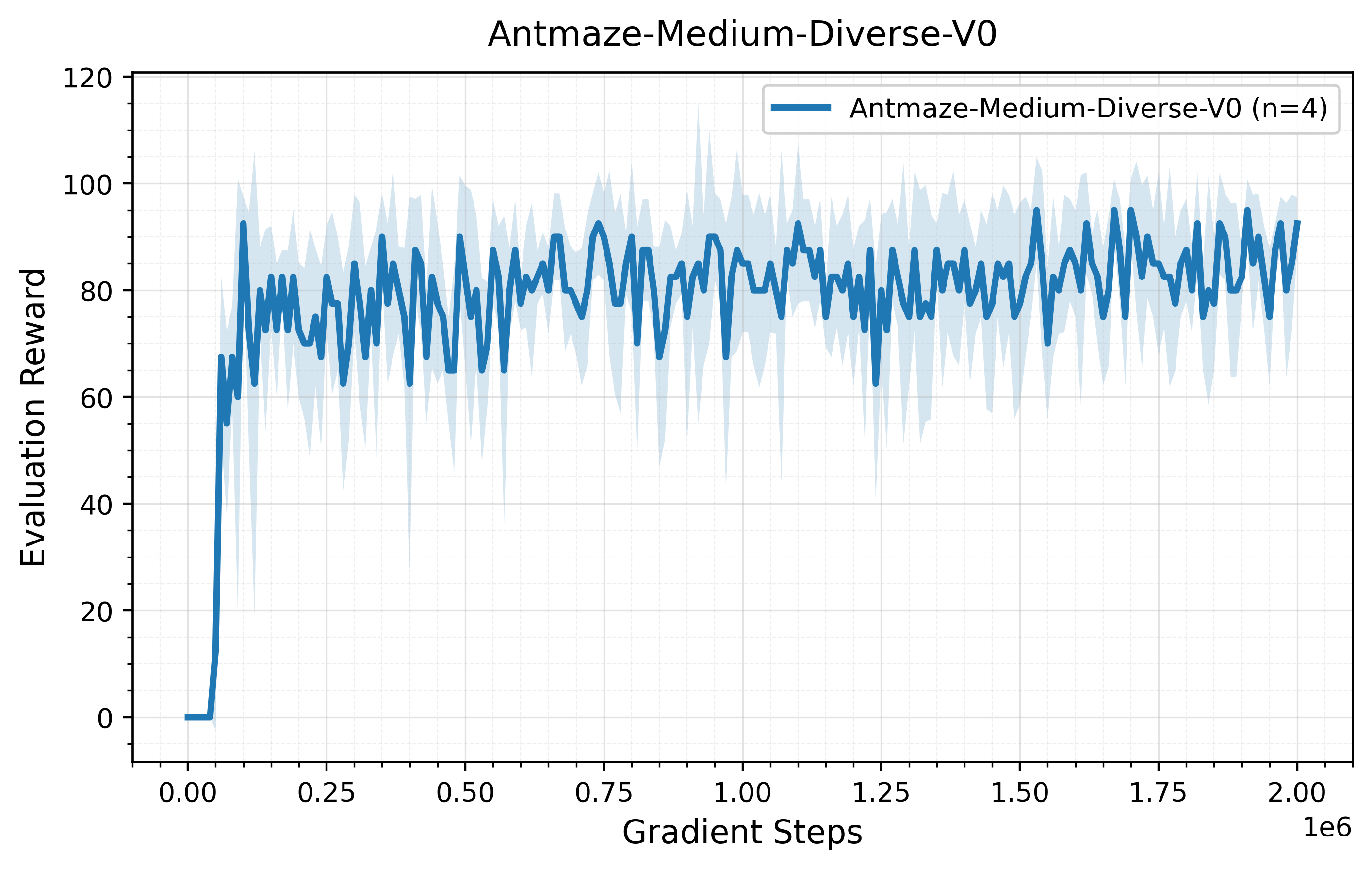
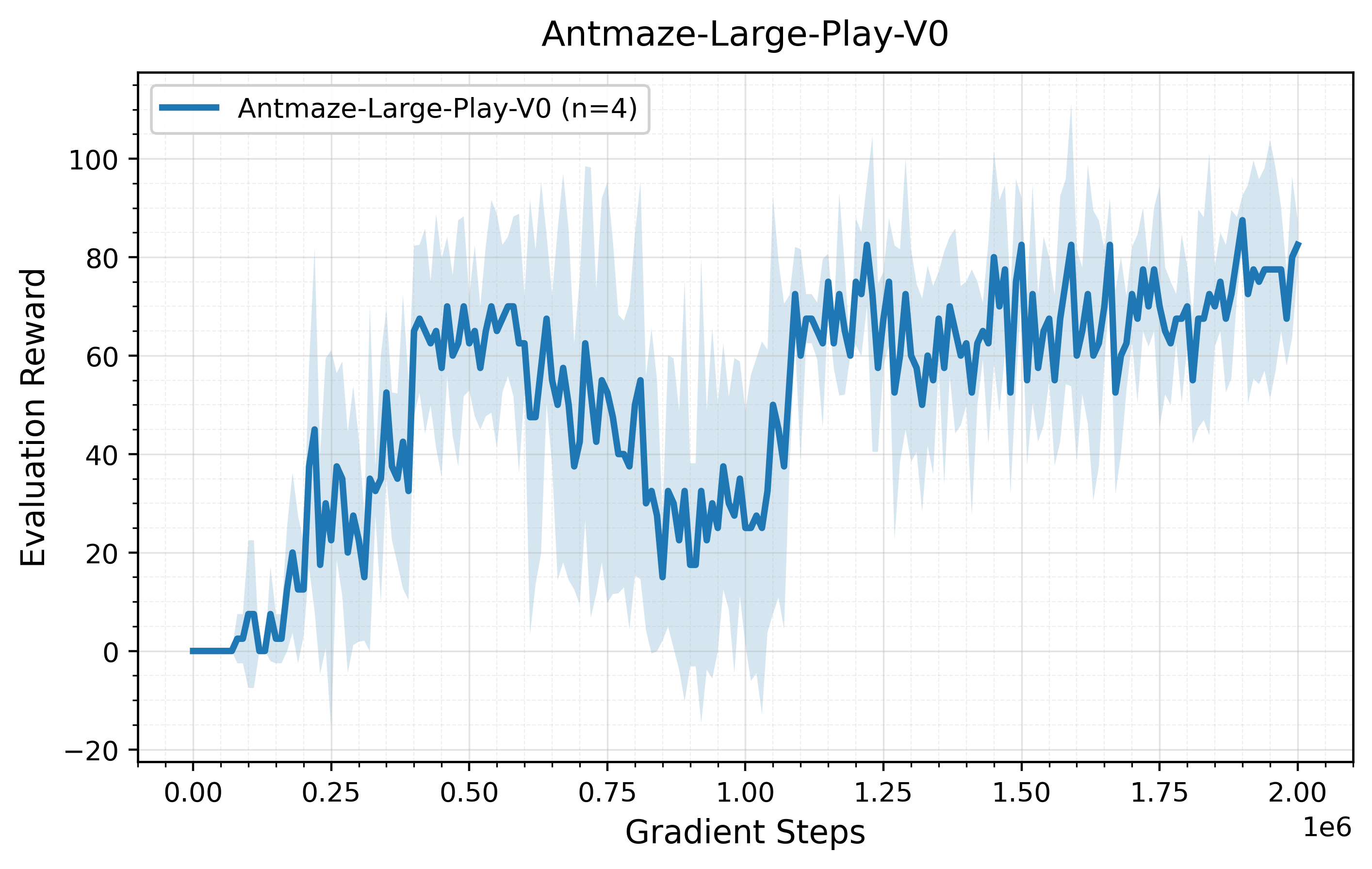
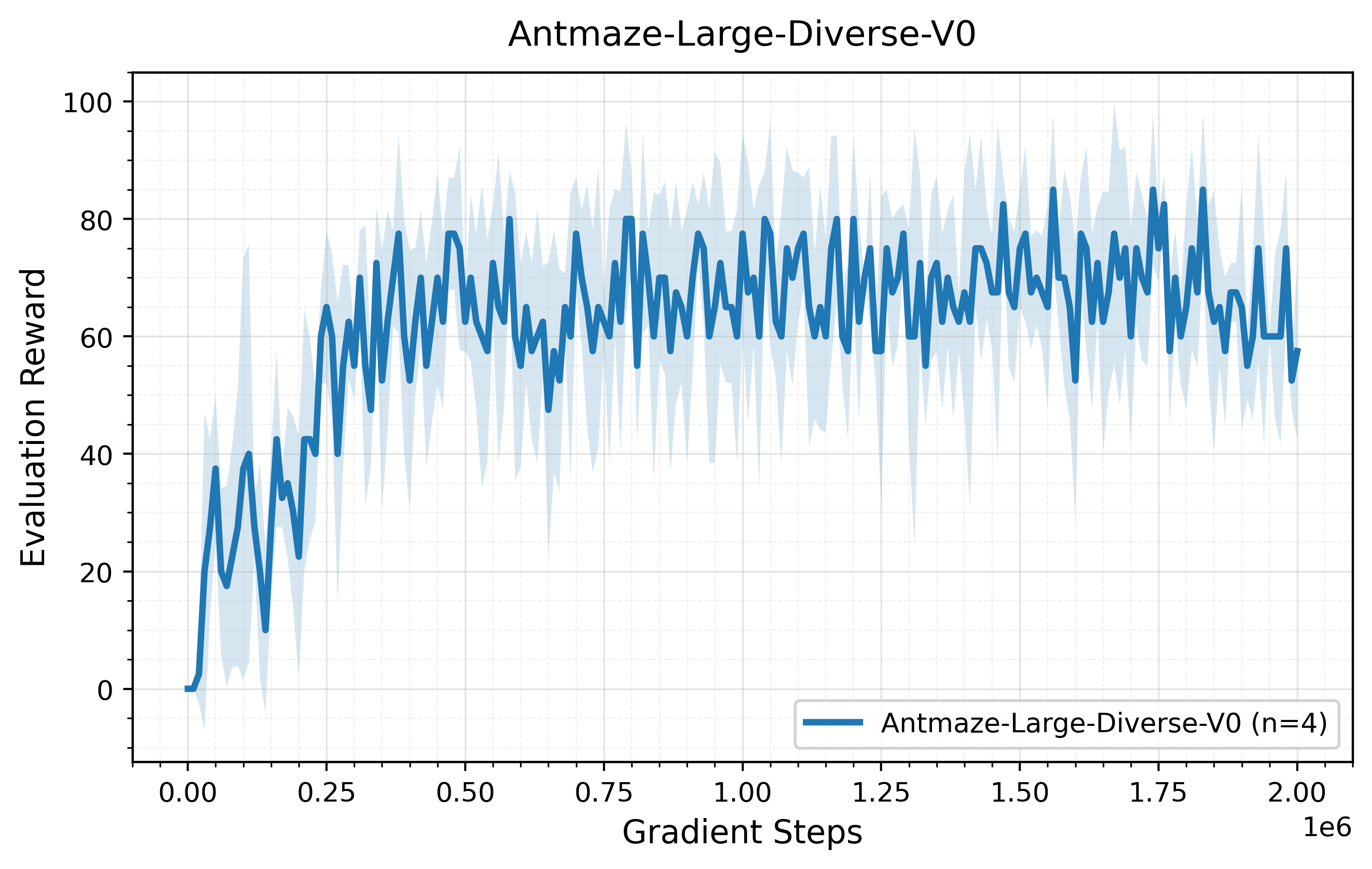
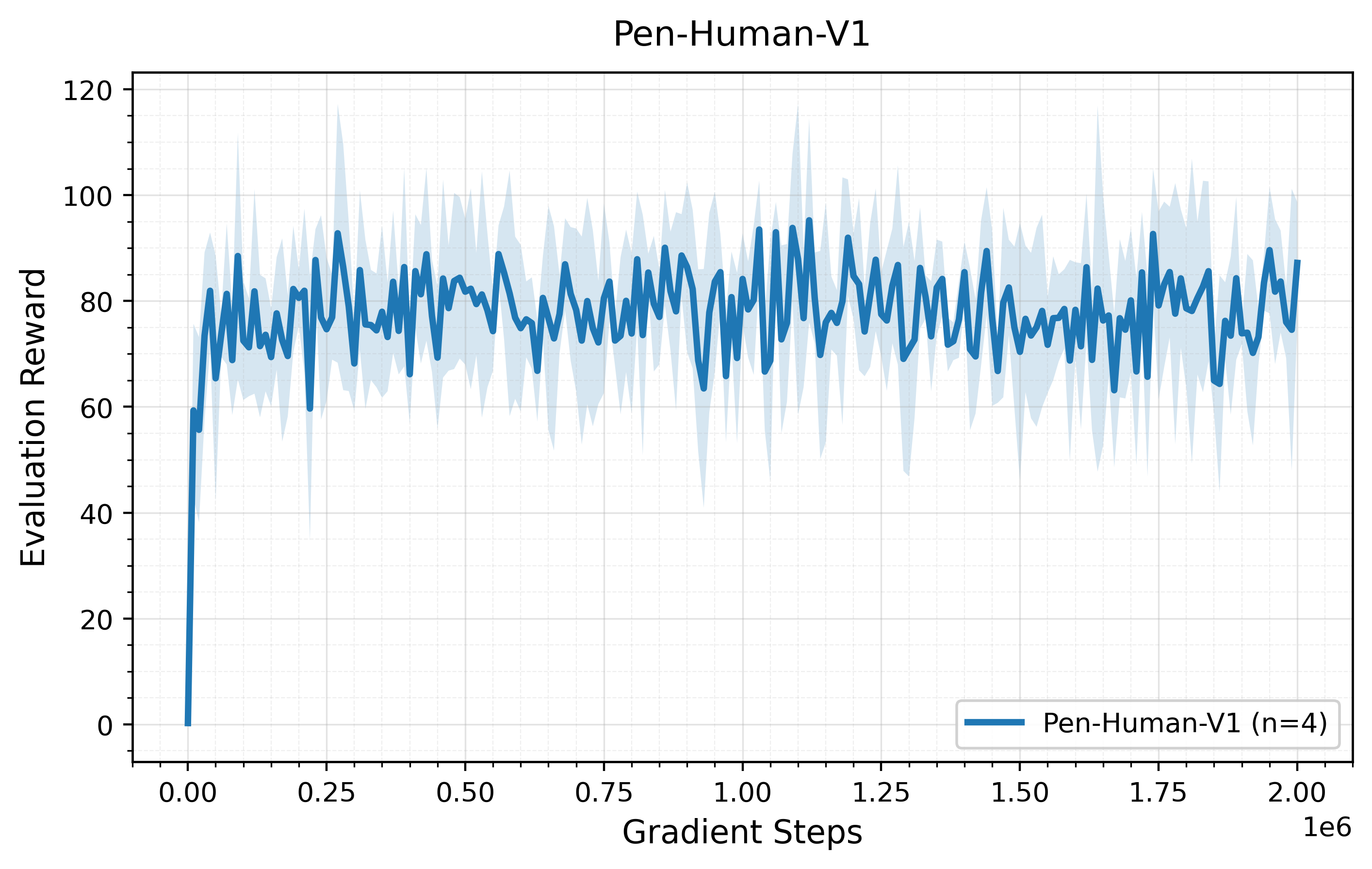
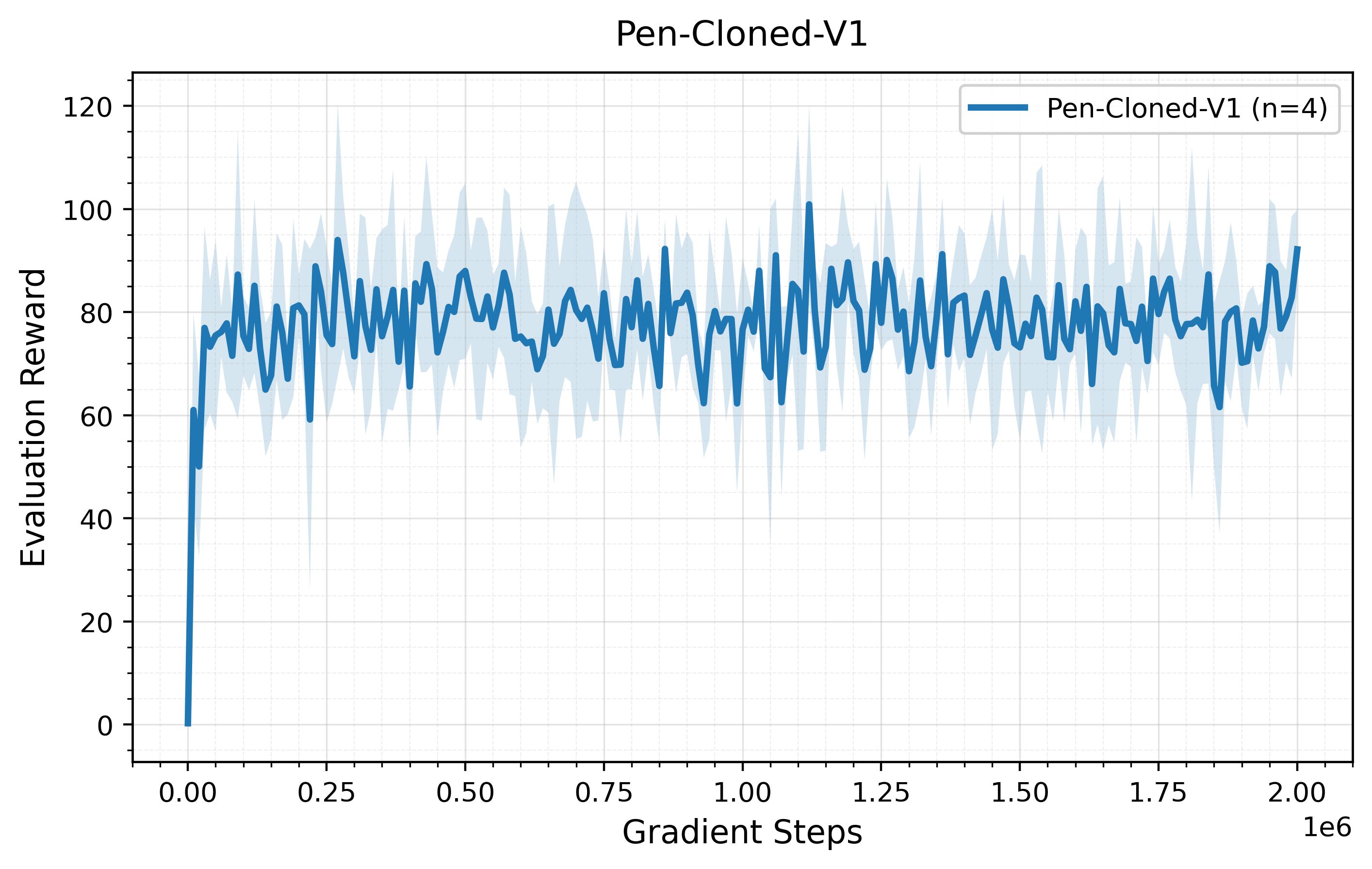
We evaluate NSAC on state-based D4RL benchmarks (locomotion, AntMaze, Adroit) and vision-based OGBench tasks, comparing against representative offline RL baselines spanning policy-regularization, conservative value estimation, and diffusion- and flow-based methods. DAC is included as the closest score-based diffusion actor–critic baseline. All results use four random seeds and a fixed budget of two million gradient steps.
Representative benchmark environments from the evaluation suite: dexterous manipulation and vision-based OGBench tasks.

Switch between benchmark groups to compare aggregate scores across methods. This view summarizes the headline results; the per-task tables and diagnostic plots are kept below for a more granular readout.
The D4RL suite spans well-behaved locomotion, sparse-reward AntMaze navigation with many suboptimal trajectories, and dexterous Adroit manipulation with limited data coverage. These settings stress the coupling between value estimation and policy optimization differently — from smooth continuous control to long-horizon, multimodal decision-making.
| Benchmark (total) | CQL | IQL | DQL | IDQL-A | DAC | NSAC |
|---|---|---|---|---|---|---|
| Locomotion (9 tasks) | 698.5 | 692.6 | 791.2 | 739.2 | 836.4 | 861.7 |
| AntMaze (4 tasks) | 145.6 | 228.3 | 258.2 | 300.4 | 275.4 | 337.2 |
| Adroit (2 tasks) | 62.4 | 108.8 | 130.1 | — | 145.2 | 168.5 |
| State-based total | 906.5 | 1029.7 | 1179.5 | — | 1257.0 | 1367.4 |
Average normalized scores on D4RL (mean over four runs). Gains are most pronounced on AntMaze, where value guidance through executable actions matters most. Full per-task numbers with standard deviations are in the paper.
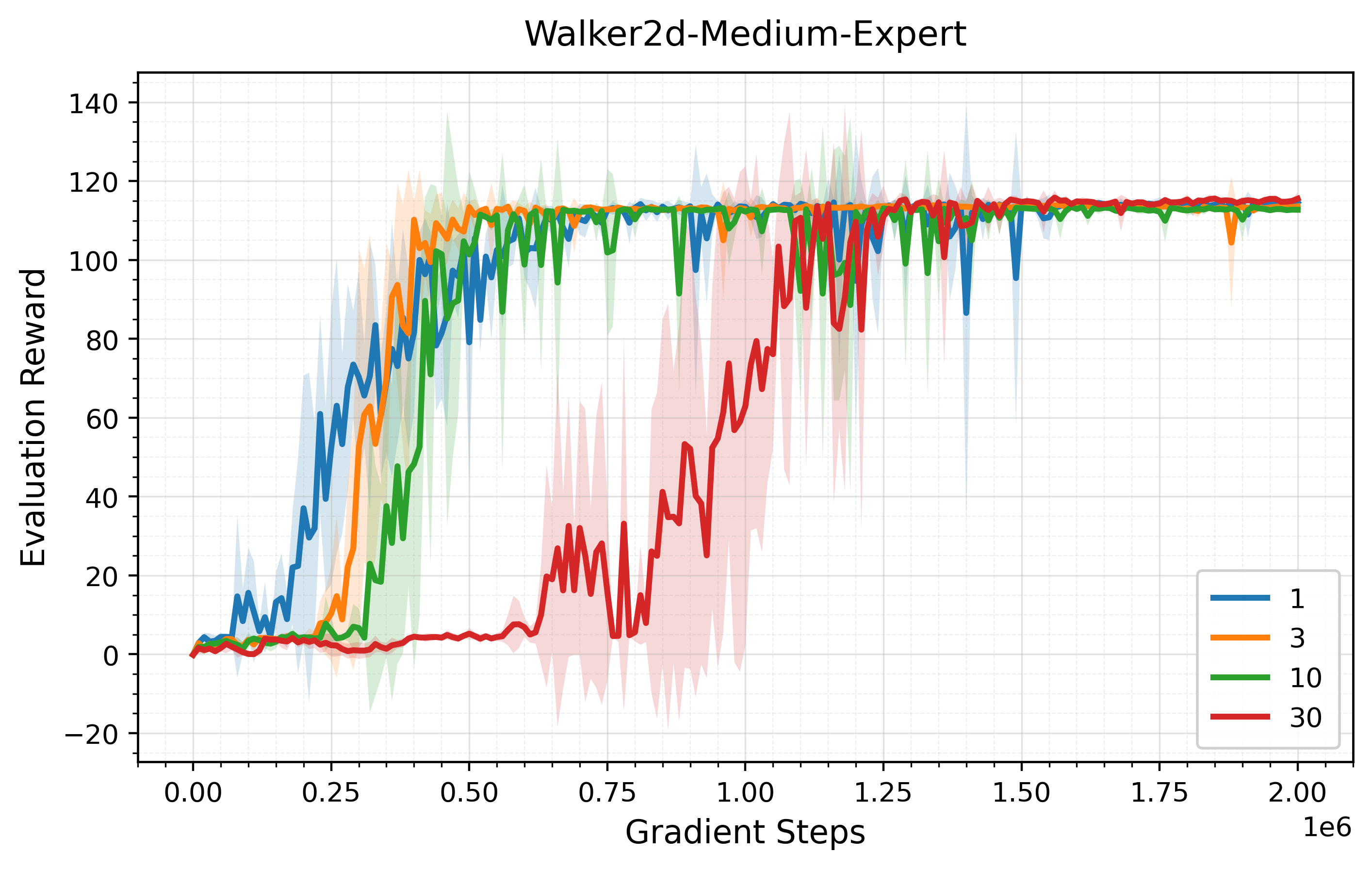
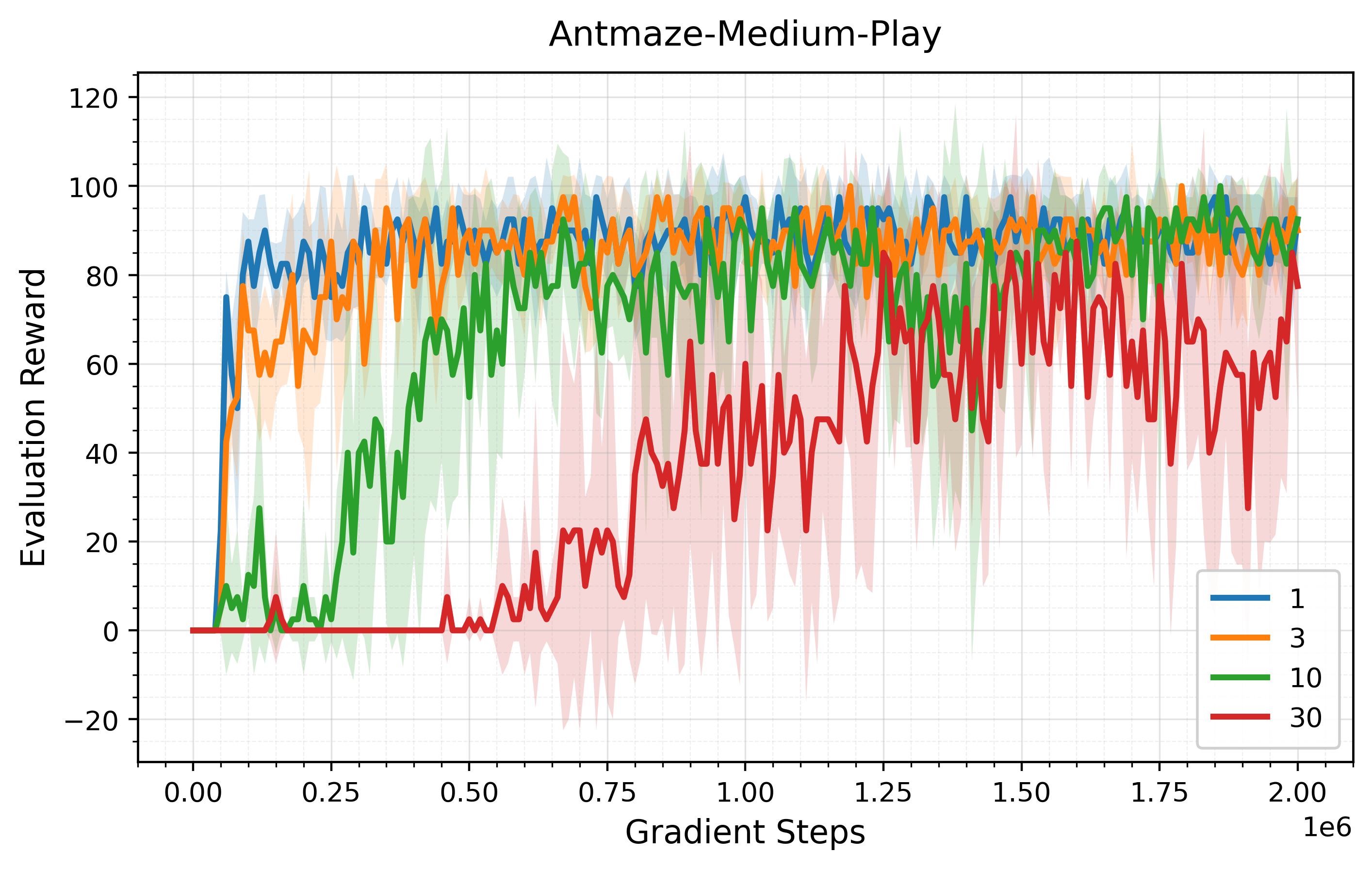
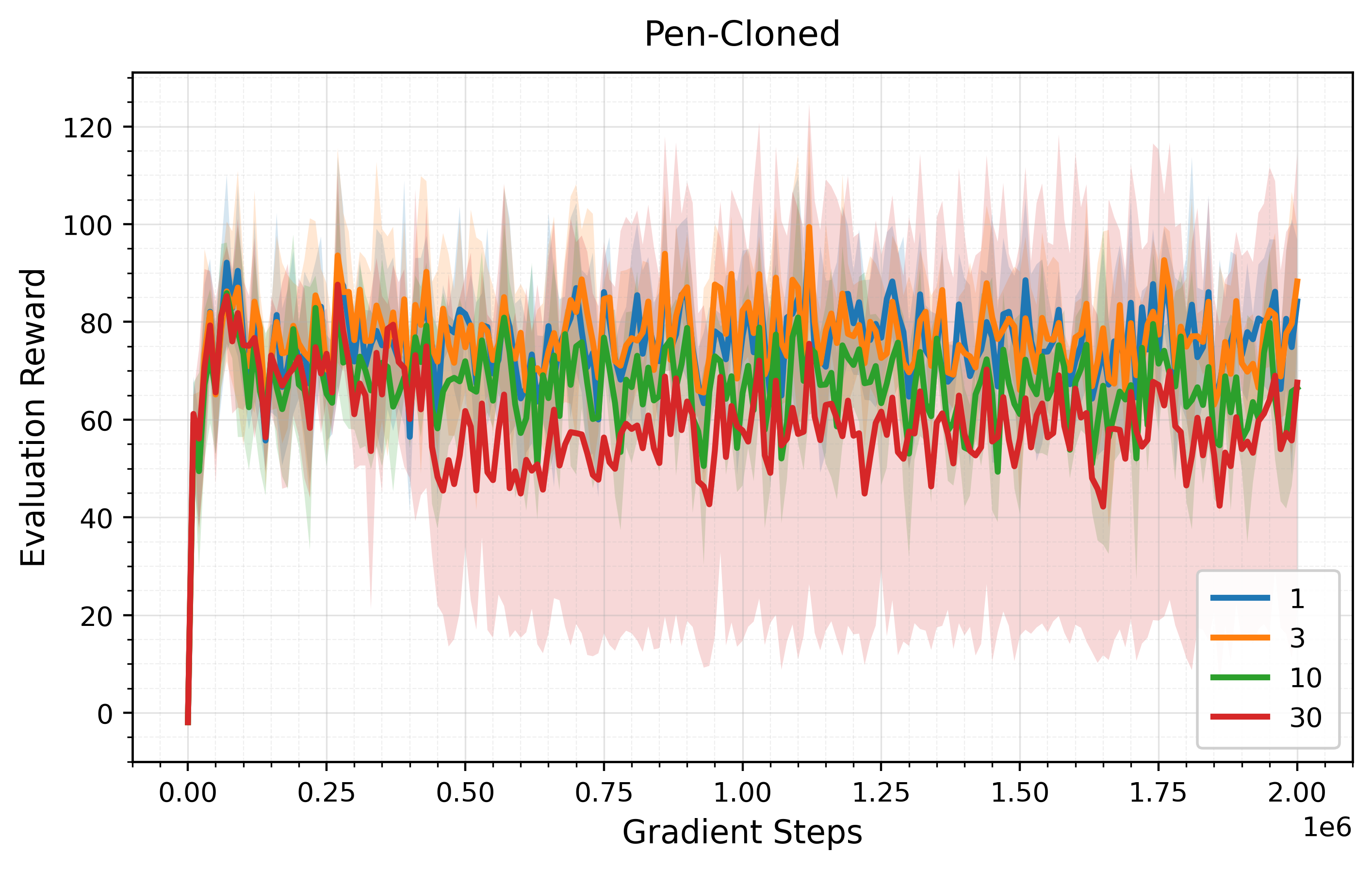
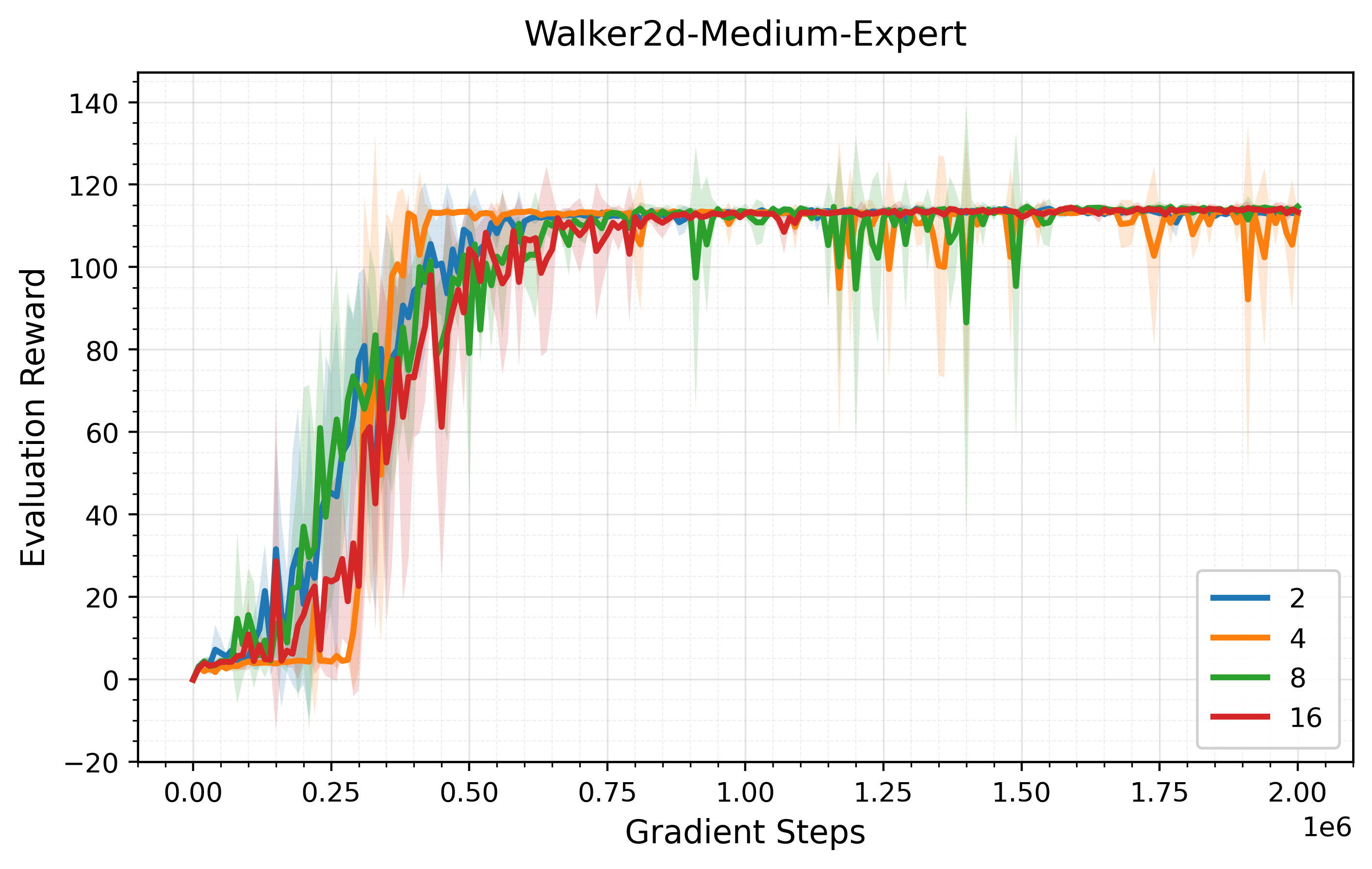
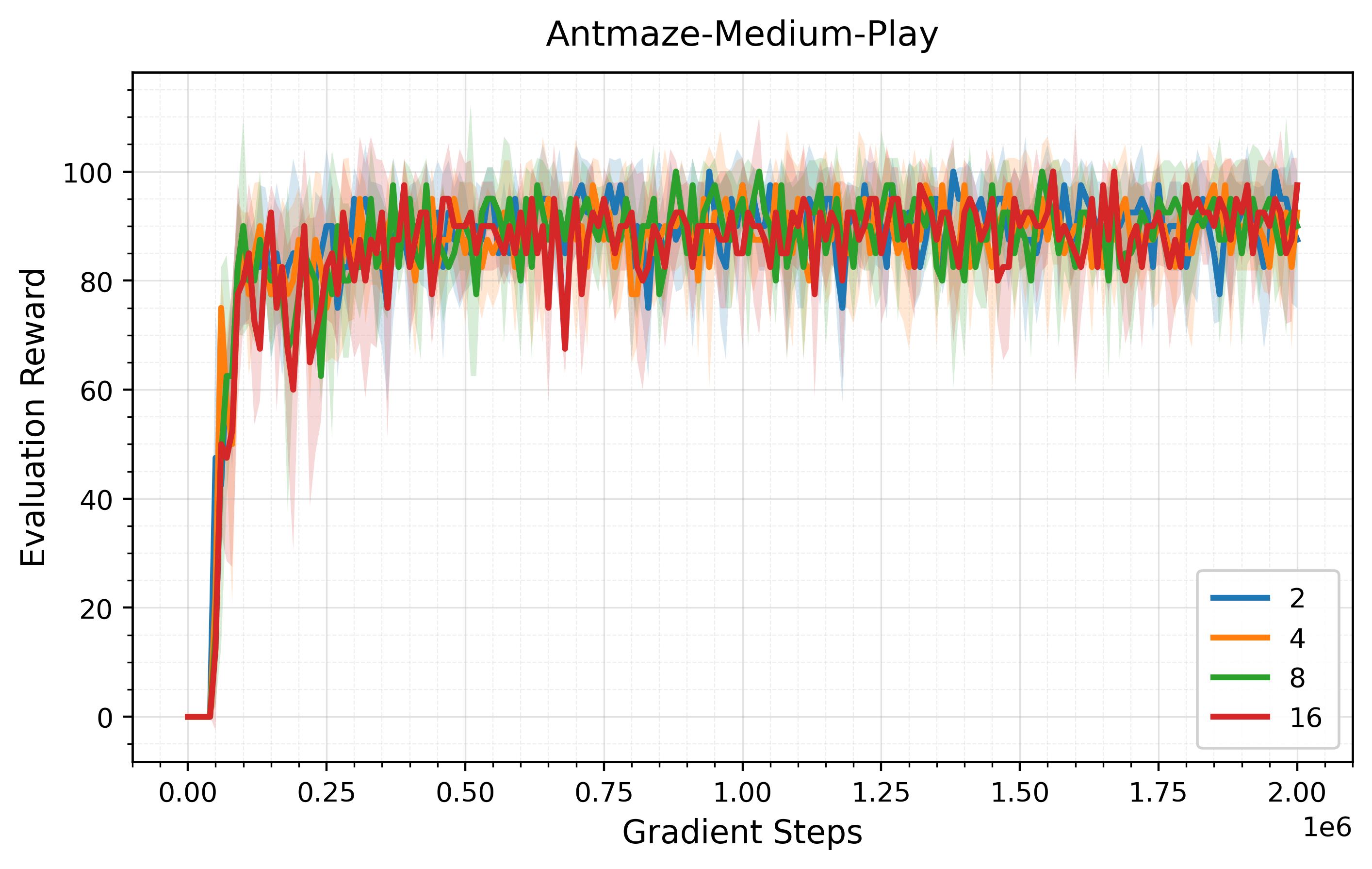
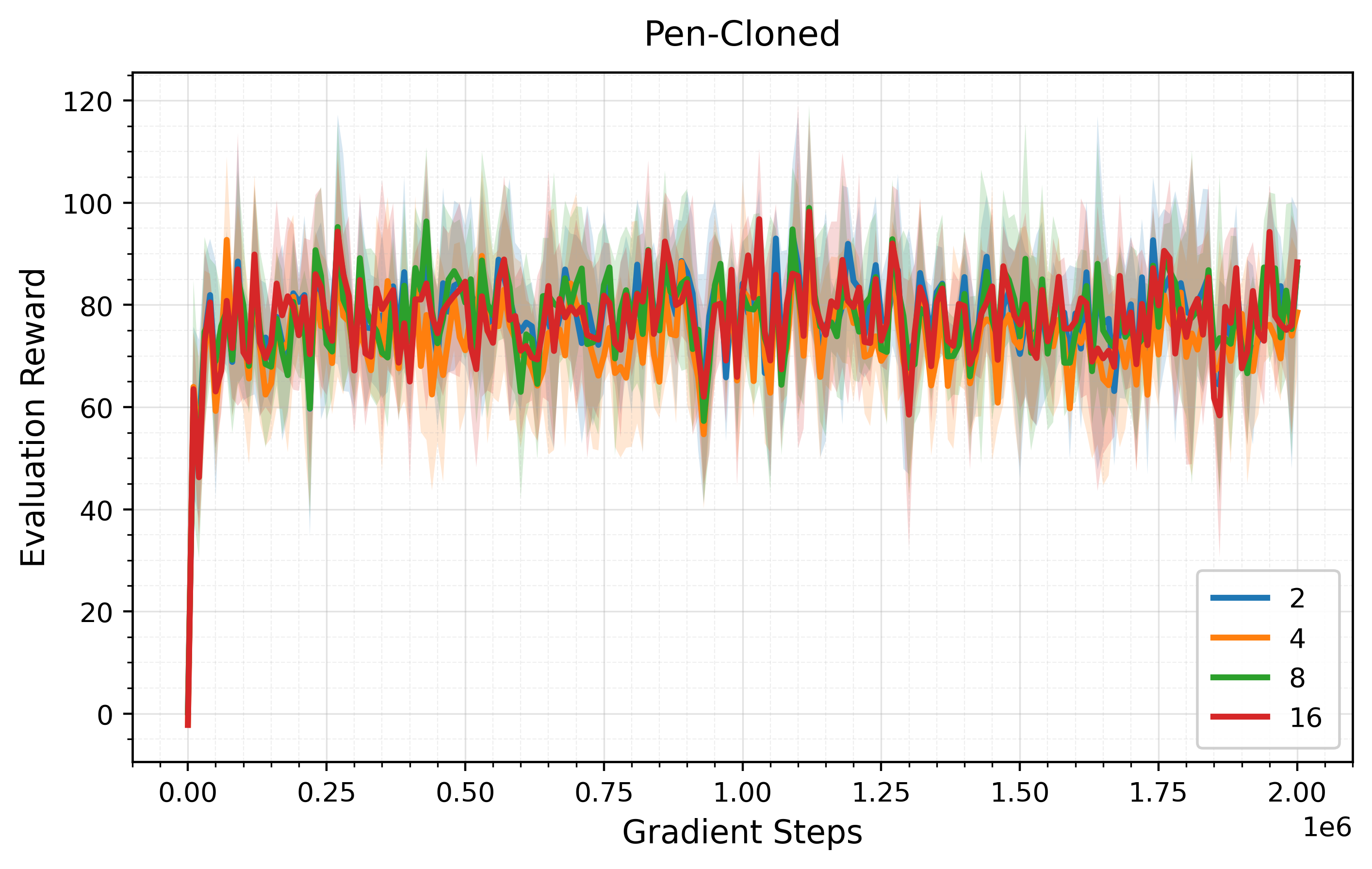
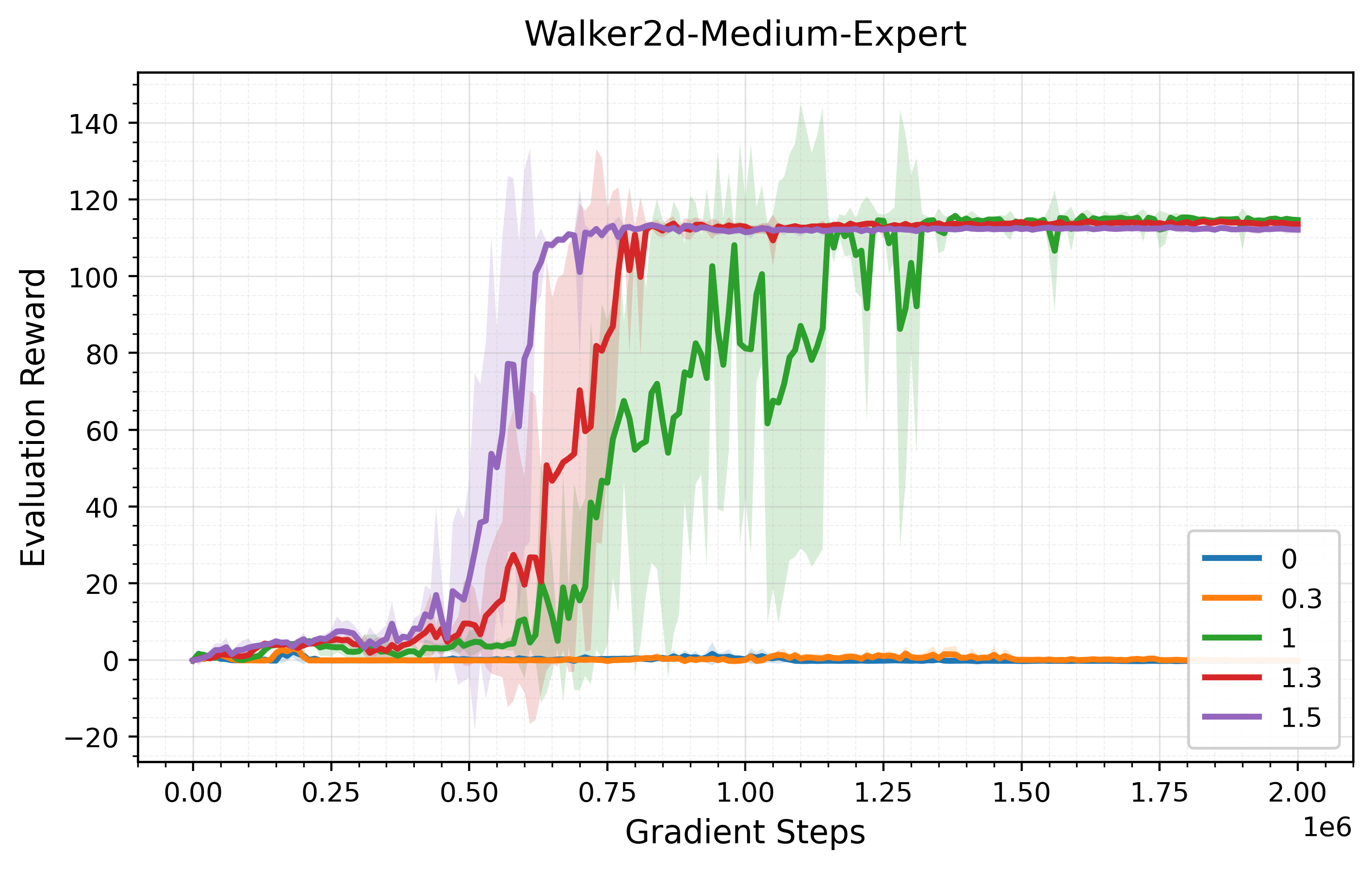
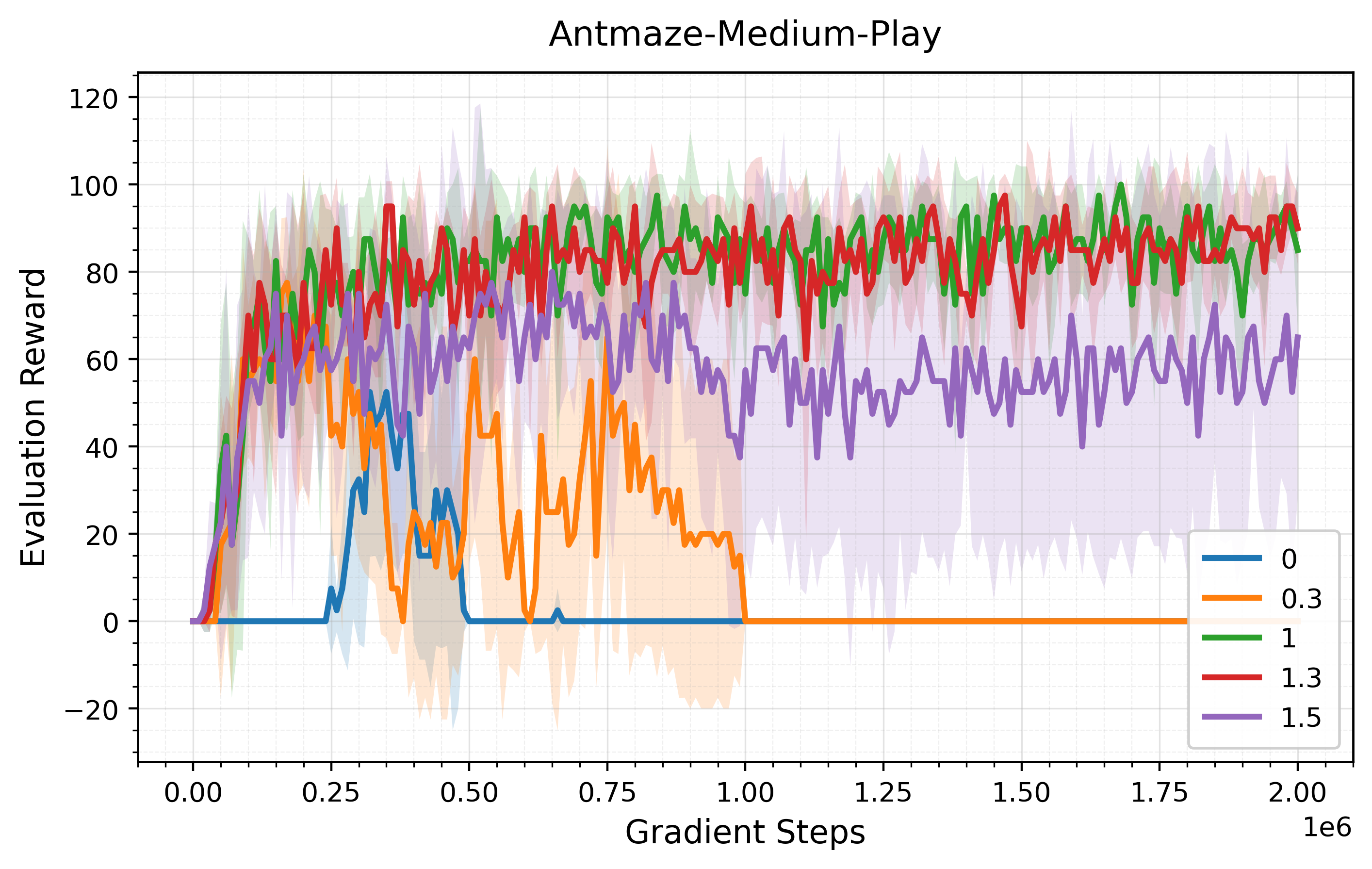
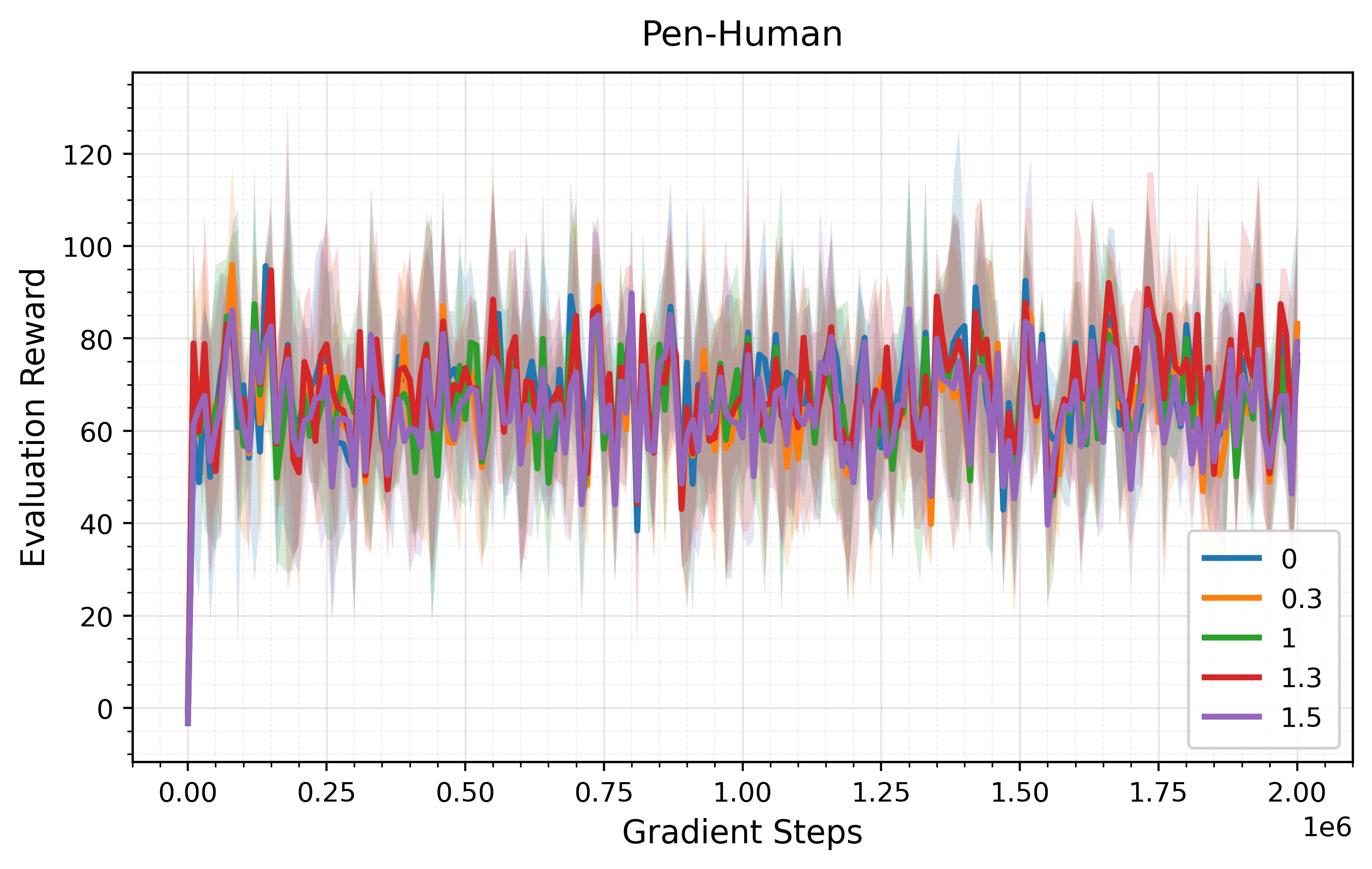
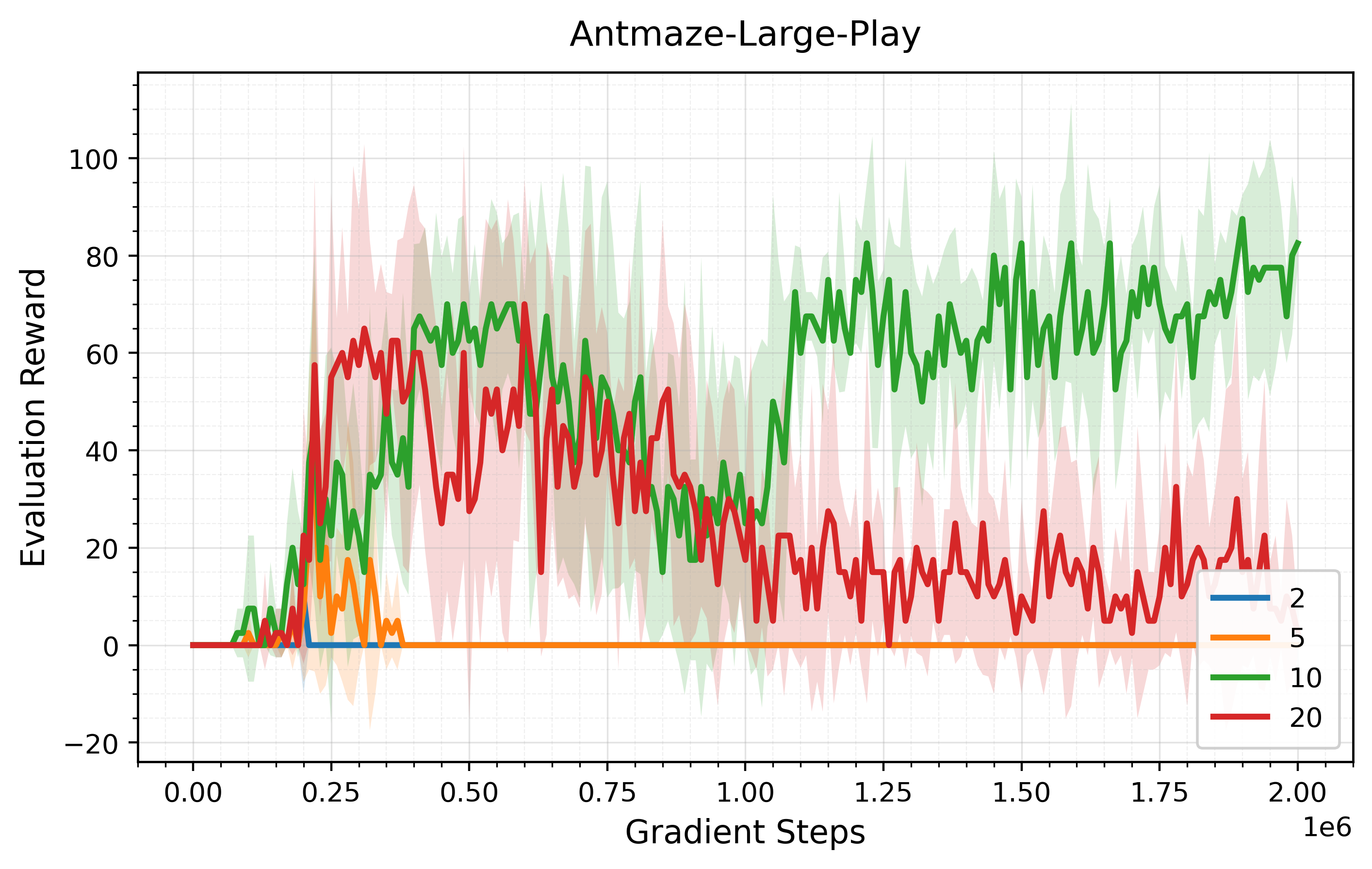
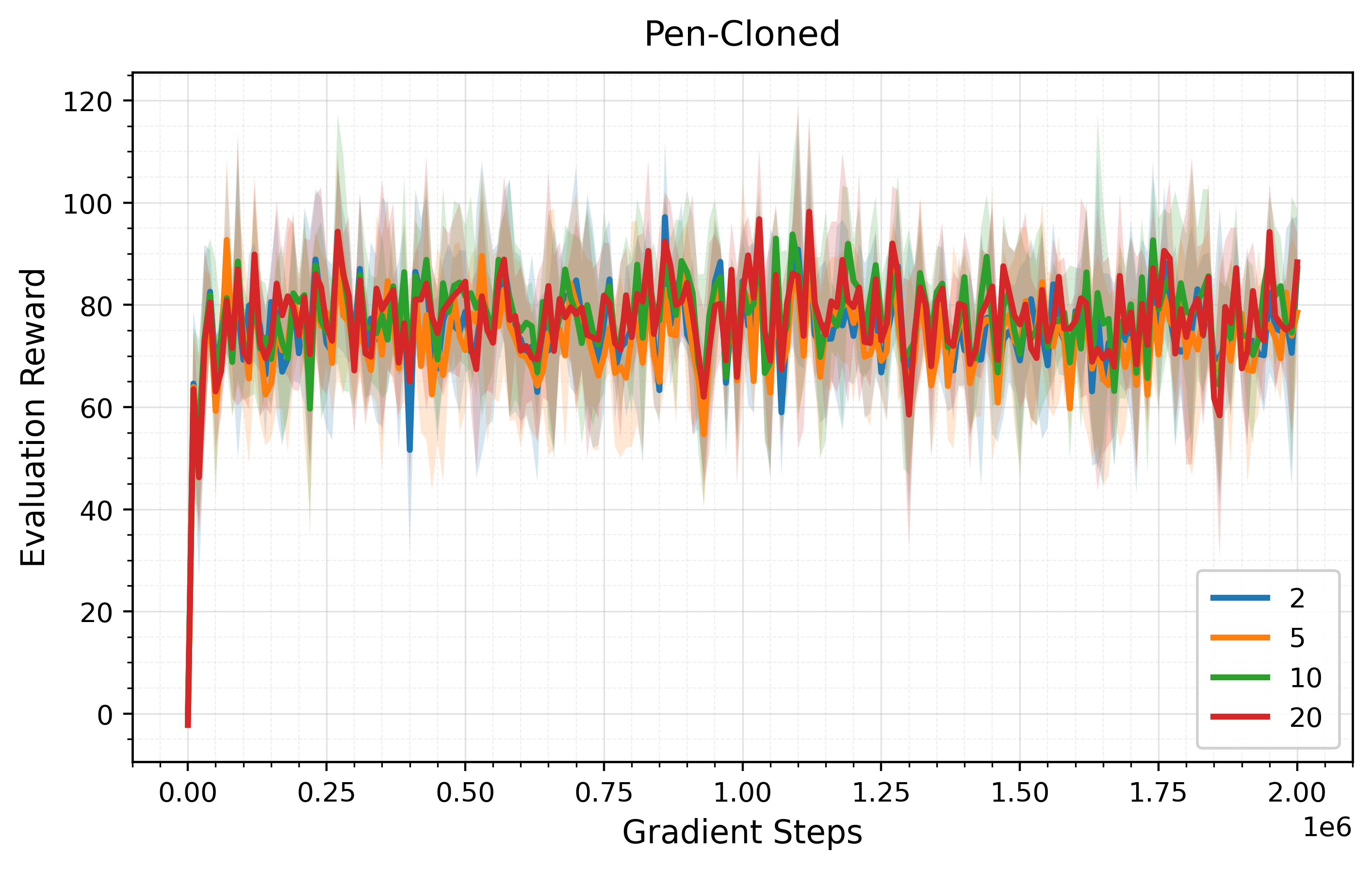
The ablations isolate the key operational levers in NSAC. Guidance strength is placed here with the other diagnostics so the experimental story stays consolidated rather than fragmented across the page.


OGBench requires learning policies directly from high-dimensional visual observations, where representation learning, multimodal action distributions, and value-based improvement are jointly challenging. We follow recent flow-policy evaluations, using a targeted baseline set of strong methods for high-dimensional visual offline RL.
| OGBench visual task | IQL | ReBRAC | FQL | DAC | NSAC |
|---|---|---|---|---|---|
| visual-cube-single | 70 | 83 | 81 | 83.7 | 88 |
| visual-cube-double | 34 | 4 | 21 | 34 | 36 |
| visual-puzzle-3x3 | 7 | 88 | 94 | 98.2 | 100 |
| visual-puzzle-4x4 | 0 | 26 | 33 | 40 | 47.5 |
| OGBench total | 111 | 201 | 229 | 255.9 | 271.5 |
Success rates (%) on vision-based OGBench. NSAC is best or near-best on every task and highest in aggregate, extending the noisy-space formulation beyond state-based control.
@inproceedings{selim2026noisyspace, title = {Noisy-Space Policy Gradient for Diffusion Policies in Offline Reinforcement Learning}, author = {Mahmoud Selim and Cristina Cipriani and Karl Henrik Johansson}, booktitle = {Forty-third International Conference on Machine Learning}, year = {2026} }